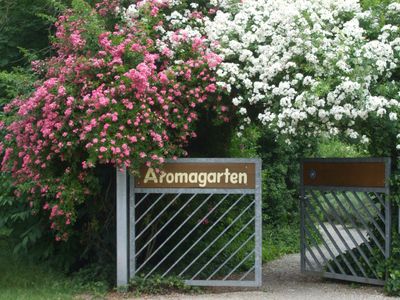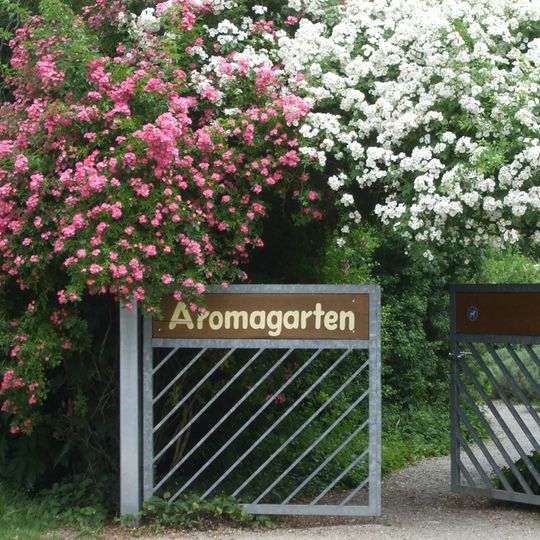
Aromagarten Erlangen, Botanical garden in Erlangen, Germany.
The Aromagarten is a public garden of Friedrich-Alexander-Universität Erlangen-Nürnberg covering 8,900 m² in the Schwabach valley, below the Ludwigsbrücke and the Palmsanlage. Around 120 native and foreign aromatic plants grow here, including American horehound, Indian nettle, tulsi and several Artemisia species. Part of the area serves the Institute of Botany and Pharmaceutical Biology as an experimental and cultivation plot.
The garden was built on the Biegelsberger Acker, a former vegetable plot of the old district hospital, after Karl Knobloch of the university's Institute of Botany and Pharmaceutical Biology pushed the project. Preparatory work began in September 1979; thousands of plants were in the ground by summer 1980, and the garden opened on 24 July 1981 as the world's first garden of its kind.
The garden's plantings include old varieties known from Franconian farm gardens alongside exotic species such as American horehound, bee balm, the Hindus' tulsi (Ocimum sanctum) and several Artemisia species. Each June the Aromagarten Day is held with special guided tours, aromatic dishes and entertainment; guided tours for school classes and children are arranged through the Botanical Garden.
The garden is open daily from April to October, 7:00 to 19:00, with free admission. The entrance lies east of the Palmsanlage street and south of the Schwabach stream, separated from it by the Martiusweg. Guided tours, including programmes for children, are listed on the Botanical Garden's website and in its "Palmenblatt" newsletter.
The grounds are not just used for walking, but actively serve as a research site where scientists study the plants and their compounds. Researchers examine how these plants can help in developing new products and understanding their properties.
The community of curious travelers
AroundUs brings together thousands of curated places, local tips, and hidden gems, enriched daily by 93,828 contributors worldwide.