Bahrebachmühlenviadukt, Railway viaduct in Borna-Heinersdorf, Germany
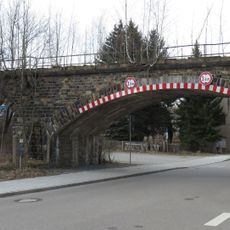
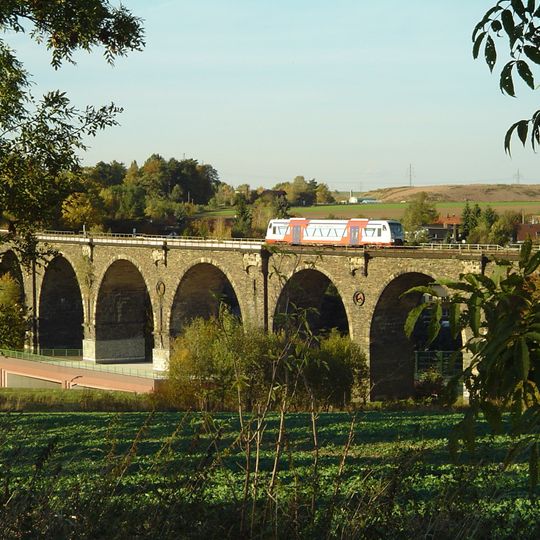
The Bahrebachmühlenviadukt is a masonry railway arch bridge over the Bahrebach near Borna, 225 m long and 27 m above the valley floor, with a largest clear arch span of 18 m. Its facing and flanking walls are of Harthau chlorite schist, while the arch surfaces and some string courses are Elbe sandstone. Since 2000–2002 the lower parts of three piers have been removed to open two widened passages for the A4.
The viaduct was built from 1868 to 1871 as part of the Leipzig–Chemnitz railway line, and rail traffic began on 8 April 1872 when the line opened. It was later placed under monument protection as a technical monument, cited as a successful example of 19th-century railway bridges. From 2000 to 2002 the lower parts of three piers were removed to widen the underpass for the six-lane A4, with work starting in 1999 and more than 400 measuring sensors installed.
The viaduct is named after the Bahrebach stream it crosses near Borna. Its masonry facing and flanking walls use Harthau chlorite schist, while the arch surfaces and some string courses are Elbe sandstone, a detail a visitor can pick out by comparing the greenish and yellowish stone.
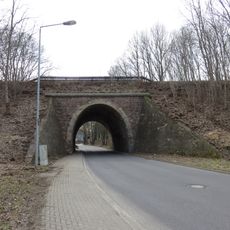
The viaduct crosses the A4 motorway between junctions 69 (Chemnitz-Mitte) and 70 (Chemnitz-Glösa), where the underpass runs at an angle rather than square to the road. The two widened passages created in 2000–2002 each carry three lanes plus a hard shoulder. The structure is a protected technical monument, visible from the motorway and the adjacent city street.
During the 2000–2002 widening of the A4, the lower parts of three piers were removed while road traffic kept running. More than 400 measuring sensors and a temporary support frame were installed from 1999 to hold the masonry, and the work was budgeted at 9 million DM.
The community of curious travelers
AroundUs brings together thousands of curated places, local tips, and hidden gems, enriched daily by 94,636 contributors worldwide.