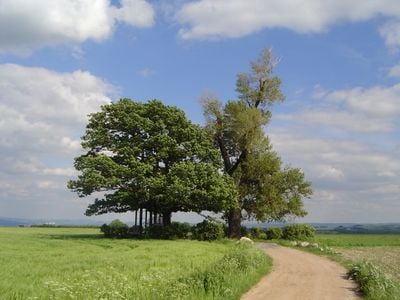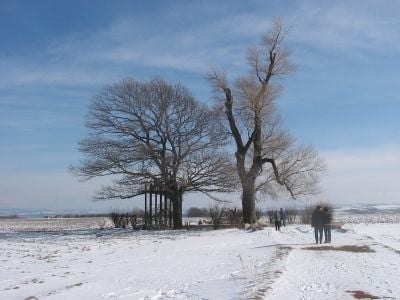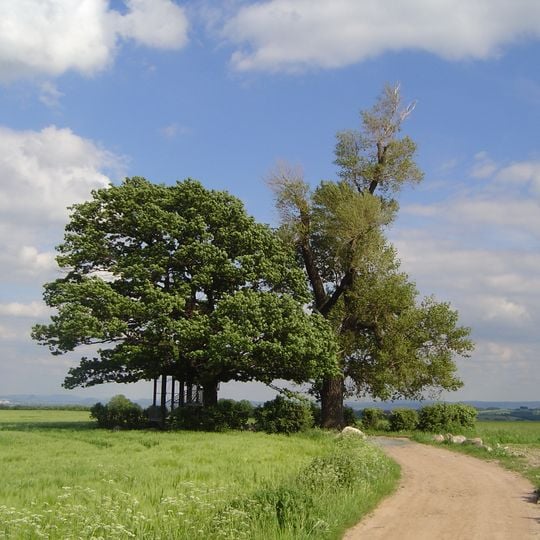
Babisnauer Pappel, Natural monument in Kreischa, Germany.
The Babisnauer Pappel is a black poplar (Populus nigra) with a trunk circumference of 5.1 metres and a height of 17.3 metres, standing alone on the Zughübel hill. Its trunk forks into two main vertical limbs; the crown is broad and twiggy, denser on one side. A wooden observation tower with a ladder and railed platform stands beside the trunk.
The Babisnau landowner Johann Gottlieb Becke planted the black poplar in 1808 as a boundary tree on the highest point of the Zughübel. In 1883 the owner Gießmann planned to fell it, so the Gebirgsverein für die Sächsisch-Böhmische Schweiz bought the tree for 300 marks on 23 March 1884. Its first viewing scaffold, about four to five metres high with 16 steps, was inaugurated on 17 May 1885.
The name refers to Babisnau, the Kreischa district 800 metres east. Since 1884 the tree has belonged to the Gebirgsverein für die Sächsisch-Böhmische Schweiz, which bought it for 300 marks to stop its felling. A legend holds that its blossom, which does not appear every year, announces the approaching end of a war; Victor Klemperer recorded this belief in Lingua Tertii Imperii. Twice a year the Wendelauf, a popular run, circles the poplar.
The poplar stands on the open Zughübel hill about 800 metres west of Babisnau, reached on foot via field paths; the surrounding ground is farmland, so stay on the paths. The viewing platform beside the trunk is reached by steps and gives a panorama toward Dresden and the Elbe Sandstone Mountains. The Bismarck oak planted in 1890 stands about ten metres away.
The poplar grows on a Cretaceous sandstone plateau where its genus would normally stand in damp lowlands; the site's thin loess-loam cover lets it thrive on the ridge. A black poplar grown from a cutting of the old tree was planted a few metres away on 8 April 2006.
The community of curious travelers
AroundUs brings together thousands of curated places, local tips, and hidden gems, enriched daily by 94,498 contributors worldwide.