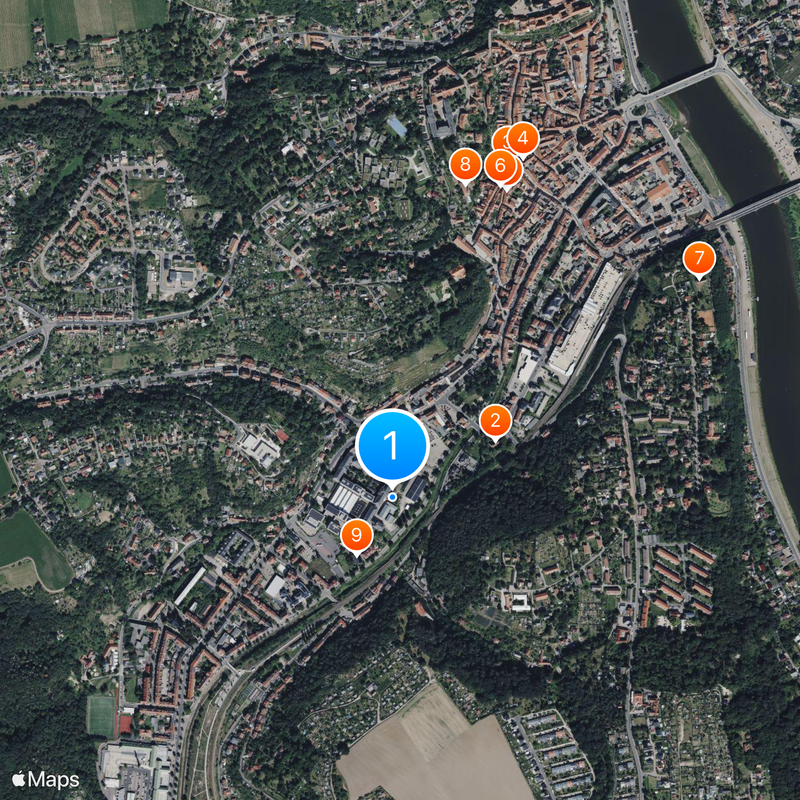
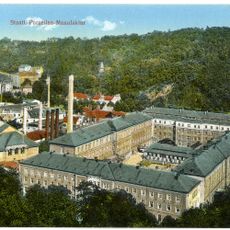
Meissen porcelain, Porcelain manufacturing facility in Meissen, Germany
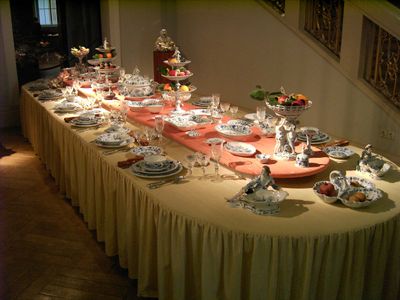
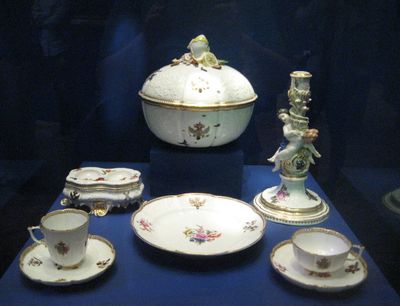
Meissen porcelain is the first European hard-paste porcelain, produced since 1710 at the royal factory in Meissen near Dresden, first housed in Albrechtsburg castle. Its wares are white, glazed and painted with overglaze enamels, and each piece carries the crossed swords mark introduced in 1720, one of the oldest trademarks still in use. The photograph shows a table set with white porcelain: stacked plates, footed compotes with oranges and lemons, lidded tureens, sauce boats, cups and a tall centrepiece of sculpted figures, most pieces painted with delicate decoration and gilded rims.
Ehrenfried Walther von Tschirnhaus and Johann Friedrich Böttger succeeded in creating hard-paste porcelain using European formulas in 1708, which led to the founding of the facility in 1710. King Augustus the Strong moved production to Albrechtsburg castle in Meissen that year to protect the manufacturing secret.
The facility introduced European decorative motifs that moved away from Chinese designs, establishing a new tradition in ceramic art. Many patterns and forms developed here became templates copied by workshops across the continent.
Guided tours take visitors through the production halls, where they can observe the steps from shaping to hand-painting. Comfortable shoes are recommended, as the route passes through several workshops.
The first wares made at Meissen were not white porcelain but a hard red stoneware known as Böttger ware, copying Chinese Yixing teapots. Böttger's version was harder than similar Dutch and English stoneware and kept crisp detail in its applied decoration. White porcelain followed, reaching the market in 1713.
The community of curious travelers
AroundUs brings together thousands of curated places, local tips, and hidden gems, enriched daily by 93,517 contributors worldwide.