Basilica Gößweinstein, Baroque basilica in Gößweinstein, Germany
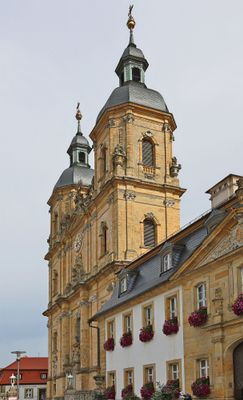
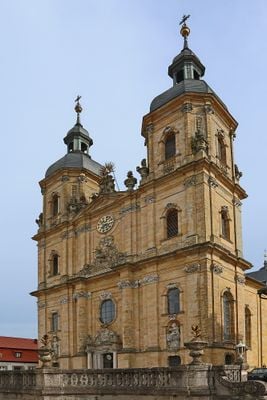
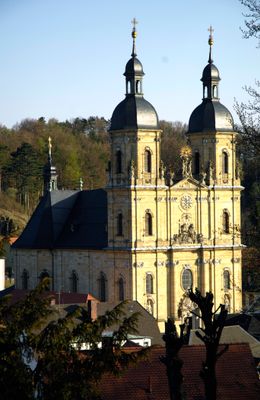
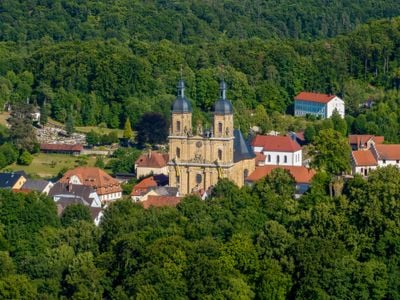
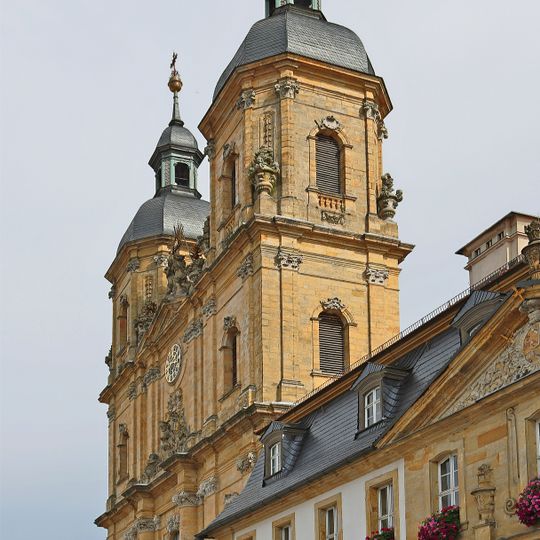
The Basilica Gößweinstein is a Baroque pilgrimage church of light brown stone with two towers of unequal height: the taller right tower carries a steep dark slate roof with a small lantern, the shorter left one a clock face. Between them, the lower facade holds a round clock with a black face and gold Roman numerals, framed by columns, carved figures and scrollwork. Balthasar Neumann's plan was begun in 1730.
The basilica was constructed between 1730 and 1739 under architect Balthasar Neumann's direction, commissioned by Prince-Bishop Friedrich Carl von Schönborn. This construction reflected the baroque artistic movement and the growing pilgrimage traditions of the era.
The pilgrimage is documented since the late Middle Ages and centres on a polychrome group of figures attributed to Hans Nussbaum, venerated in a chapel built by Gosuinus. Around 140 permanent pilgrimage groups come each year, and the main pilgrimage day is Trinitatis, the Sunday after Pentecost. From 26 to 27 December a 24-hour prayer is held, after which fires are lit in the village and on the surrounding slopes.
The basilica stands on a slope above the Wiesent valley in the centre of Gößweinstein, with the main portal facing the church square. Since 2009 a marked Way of St. James passes the building. A 24-hour prayer runs from 16:00 on 26 December to 16:00 on 27 December, after which fires are lit in the village and on the surrounding hillsides.
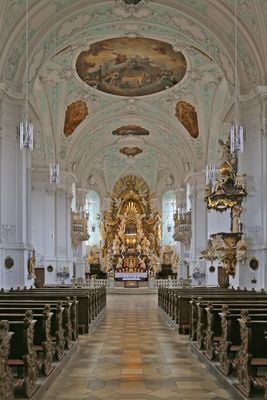
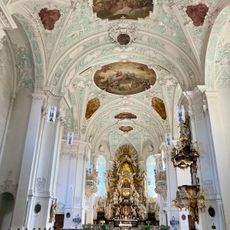
The high altar, completed between 1740 and 1743 under Johann Michael Küchel, is built as a three-tiered pyramid whose figures and ornaments form three interlocking triangles, a reference to the Trinity. The church also holds a late-medieval polychrome group attributed to Hans Nussbaum.
The community of curious travelers
AroundUs brings together thousands of curated places, local tips, and hidden gems, enriched daily by 94,059 contributors worldwide.