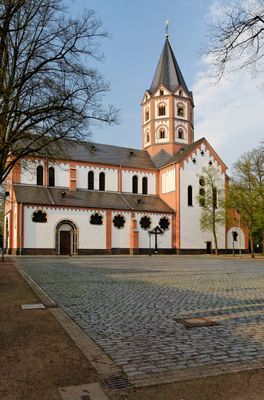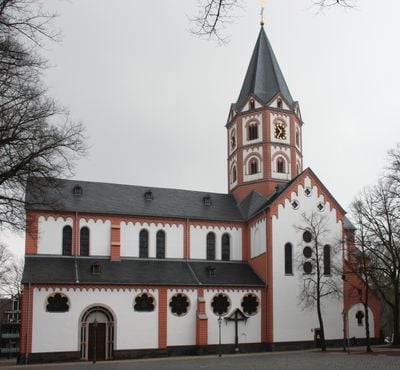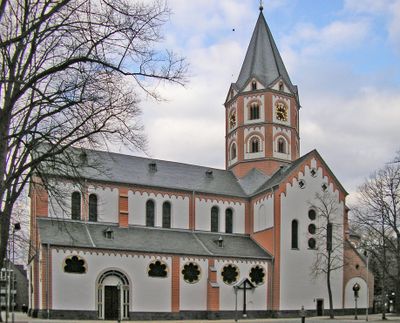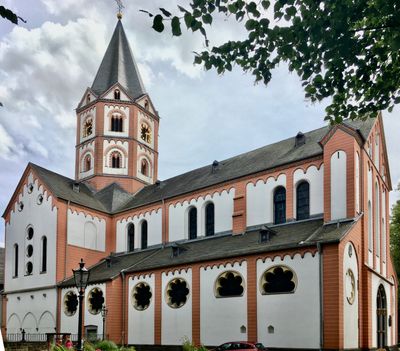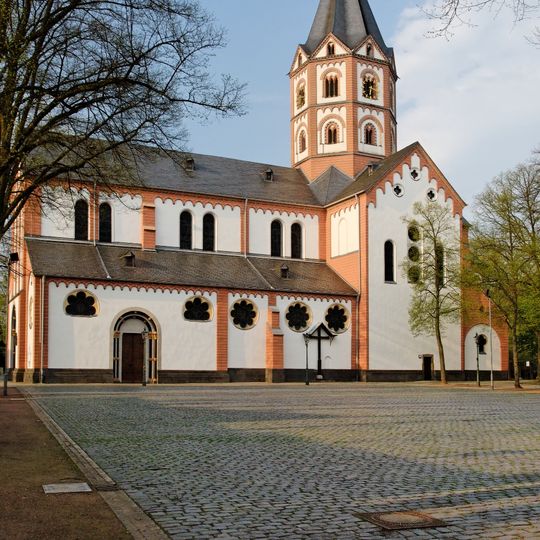
Basilika St. Margareta, Romanesque church in Gerresheim, Germany.
St. Margareta is a pillared basilica built between 1220 and 1230 in the Rhineland transitional style, consecrated around 1236. Its west facade sets a raised central nave against lower side aisles, and a two-storey octagonal tower with a pointed folding roof rises above the crossing. The exterior is uniform in form; the interior carries the full colour and ornament of late Rhenish Romanesque with early Gothic touches. The outer walls were given a plaster and paint finish in the 1974–1985 restoration.
Construction of the basilica began in 1220 under Abbess Guda von Berg and it was consecrated in 1236. This important religious structure has remained standing for nearly 800 years.
Since 1598 the Blutprozession has been held here each year, honouring a relic said to contain earth from Golgotha mixed with the blood of Christ. The church was reserved for the canonesses until the 18th century; the parish only moved its services into the collegiate church from 1790.
The church is open to visitors during regular services and offers guided tours for those interested. Additional information about the building can be found through local heritage groups.
The crucifix above the altar is Ottonian, carved from oak around 960, and measures 2.10 m high with a 1.80 m arm span; it likely came from the 9th-century predecessor church and is tied to the 970 consecration. Traces of its original paint survive, and Christ's face is modelled softly, with little shaping of the body.
The community of curious travelers
AroundUs brings together thousands of curated places, local tips, and hidden gems, enriched daily by 92,880 contributors worldwide.