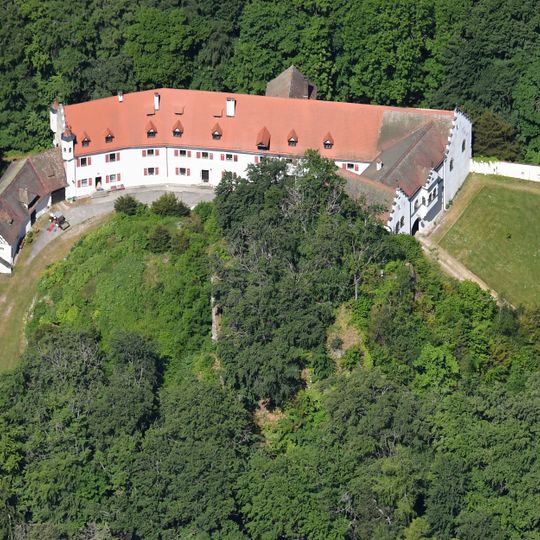
Schloss Neidstein, Medieval château in Etzelwang, Germany.
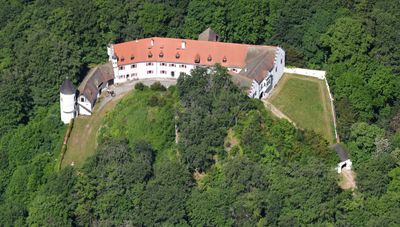
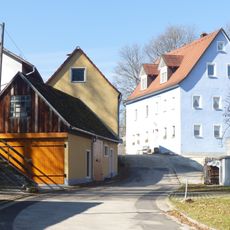
Schloss Neidstein is a 16th-century château in Etzelwang, Upper Palatinate, built as an elongated wing with an eastern gatehouse and a round tower at the west end, completed in 1513. Its present look, with stepped gables, dates from a remodelling between 1855 and 1860. The pale walls have rows of rectangular windows, some with red shutters, under a steep red-tiled roof with curved dormers, white chimneys and a conical-roofed corner turret at the left end.
A Neipert Nitstein is named in 1119 as a ministerialis of the Counts of Sulzbach, and the castle passed to the Wittelsbachs by 1326. On 10 February 1466 Duke Ludwig pledged it to Hans von Brandt; the pledge was never redeemed, and the family held Neidstein until 2006. Jobst von Brand built the new castle, completed in 1513.
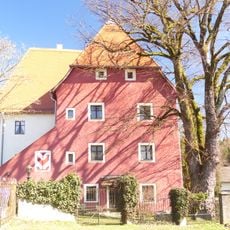
On one wall of the castle are Old Testament reliefs carved by Georg Schweiger of Amberg in the 17th century. A smiling portrait of the artist is accompanied by verse lines. The reliefs are the work to look for on the facade, alongside the stepped gables added in 1855–1860.
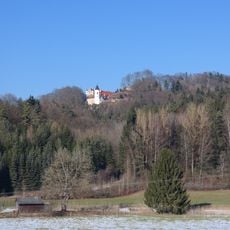
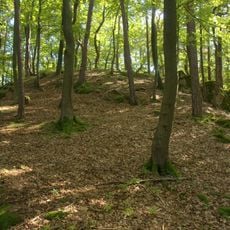
The castle stands on a spur of the Schlossberg above Tabernackel, south of Etzelwang, inside the 17.78-hectare Schergenbuck nature reserve established in 1973. It is a private conference venue, not a museum, so access is not open to casual visitors. The original castle ruins lie on the summit above the present building.
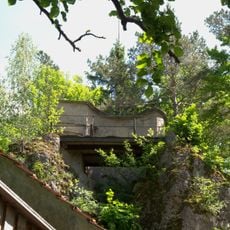
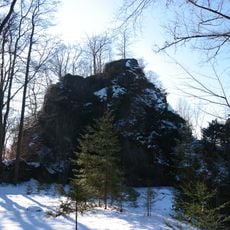
Above the château, on the summit of the Schlossberg (also called Schergenbuck, 527.5 m), stand only scant remains of the original Burg Neidstein. The château's archive, about 17 running metres of manorial and family records, was reportedly strewn before the horses of passing French troops in 1796; since July 2006 it has been on deposit at the Staatsarchiv Amberg.
The community of curious travelers
AroundUs brings together thousands of curated places, local tips, and hidden gems, enriched daily by 94,228 contributors worldwide.