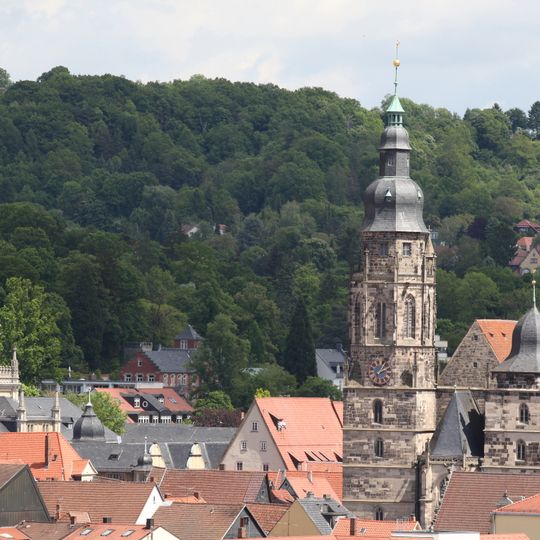
Morizkirche, Gothic church building in Coburg, Germany
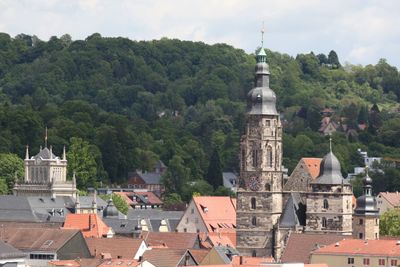
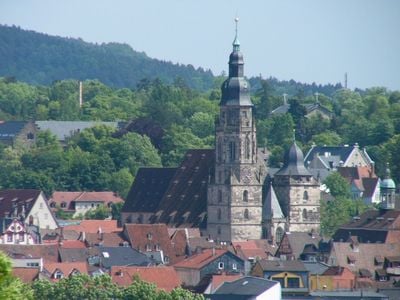
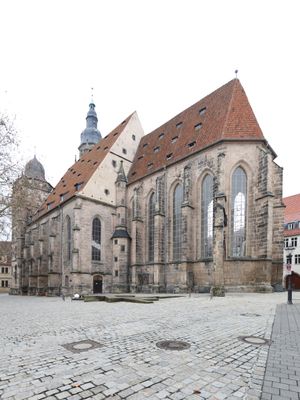
Morizkirche is a late Gothic hall church, 62 m long and up to 33 m wide, with a long eastern choir closed by a five-eighth apse and a rib-vaulted ceiling. Its west front carries two dissimilar towers: the north one topped by a Welsh dome and lantern, the south one, called Rabenturm, left unfinished and slate-clad in 1560. The nave is a flat-ceilinged hall of three equal-height aisles on eight columns, with two-tier galleries.
Construction began around 1310 to replace an earlier Romanesque structure, with the eastern choir completed by 1330. Over subsequent centuries, the building underwent modifications and in the 18th century received Baroque interior alterations that layered new aesthetics over its Gothic foundation.
The church became a key site in Protestant history when Martin Luther preached here in 1530, leaving a lasting impact on the region's religious identity. Visitors today can experience the spaces that shaped this important moment in German reformation.
The church belongs to the town of Coburg and serves as the main church of the Protestant St. Moriz congregation. It was closed for renovation as of early 2016 and reopened to visitors in December 2023. The ducal tomb lies inside the choir, so access depends on current opening arrangements rather than fixed daily hours.
The 13-metre alabaster epitaph for Duke Johann Friedrich II, carved by Nikolaus Bergner and finished in 1598, replaced the high altar at the end of the choir. The organ, built by Wolfgang Heinrich Daum in 1740, was reconstructed and fitted with a Karl Schuke instrument in 1989.
The community of curious travelers
AroundUs brings together thousands of curated places, local tips, and hidden gems, enriched daily by 93,100 contributors worldwide.