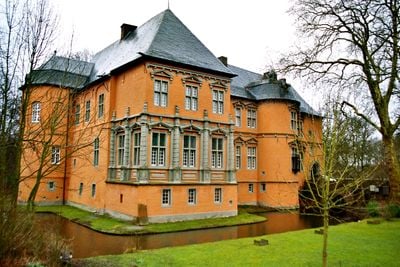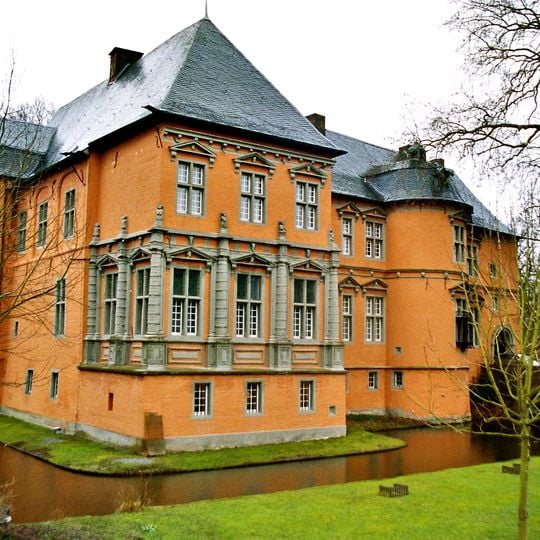
Schloss Rheydt, Renaissance castle in Mönchengladbach, Germany.
Schloss Rheydt is a Renaissance castle in Mönchengladbach featuring stone walls, defensive bastions, and a surrounding moat. The complex displays multiple architectural elements from this period arranged around a central building core with fortified outer areas.
A wooden motte probably stood here before 1000; the castle was first documented in 1180, when Archbishop Philip of Heinsberg acquired feudal rights from the lords of Rheydt. Otto von Bylandt had Maximilian Pasqualini rebuild it from 1558 to 1591 as a three-part moated palace with gatehouse, bastions and casemates. The town of Rheydt bought it in 1917, and restoration from 1988 to 1993 opened the walls and casemates to visitors.
Since 1922 the palace has housed the Städtisches Museum Schloss Rheydt, whose collection covers Renaissance and Baroque art and objects as well as the textile history of Mönchengladbach. The Vorburg hosts temporary exhibitions on local history, such as a 2004 show on Hugo Junkers. In summer the inner courtyard is used for the open-air concert series Sommermusik Schloss Rheydt, where BAP, UB40 and Roger Cicero have performed, and a medieval market with jousting displays is held annually.
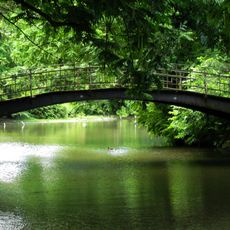
The complex is entered via a brick arch bridge on stone piers that replaced the former drawbridge with a reinforced-concrete structure. The gatehouse, outer bailey and main house are linked by two water-filled moats fed by the Niers, and the ramparts and parts of the casemates are accessible. The site is a listed monument (No. Sch 006 a-c, listed 24 September 1985).
The castle received recognition as European Museum of the Year in 1978, a rare honor for a regional German institution. Visitors can still admire original Renaissance fireplaces and statues from Pasqualini's renovation work today.
The community of curious travelers
AroundUs brings together thousands of curated places, local tips, and hidden gems, enriched daily by 92,925 contributors worldwide.