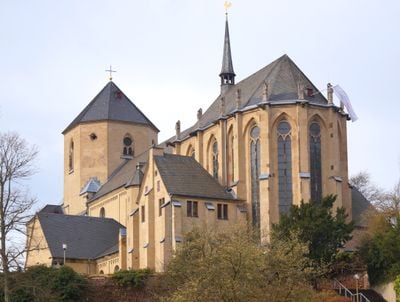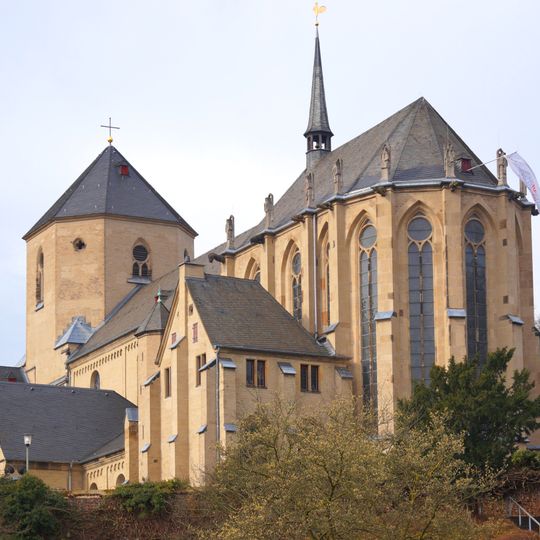
Basilica of St. Vitus, Mönchengladbach, Romanesque minor basilica in Mönchengladbach, Germany.
The Basilica of St. Vitus is a Romanesque church with a massive westwork from the late 12th century, a nave rebuilt between 1228 and 1239, and a Gothic choir constructed from 1256 to 1277 by Gerhard von Rile, the architect of Cologne Cathedral. The building is made of light tan stone, with a square tower topped by a steep pyramidal roof and a slender cross, and a polygonal choir with tall pointed windows and a dark spire with a golden weathervane.
Archbishop Gero of Cologne founded the Benedictine abbey around 974, installing the reform monk Sandrad as first abbot; the church served the monastery until its dissolution in 1802. Around 1100 a new basilica was begun, and at the end of the 12th century the massive westwork still visible today was built. The nave followed in 1228–1239, and between 1256 and 1277 Master Gerhard, architect of Cologne Cathedral, rebuilt the choir in Gothic style; Albert the Great consecrated the church on 28 April 1275.
The church keeps a piece of cloth said to have covered the table at the Last Supper, kept in a golden casket and shown to the faithful every seven years. Since 1802 it has served as a parish church, and in 1974 Pope Paul VI raised it to minor basilica status for the 84th German Catholic Day and the abbey's 1000th anniversary.
The location is centrally situated in the heart of Mönchengladbach, making it straightforward to visit. Guests should observe standard behavior expectations in religious spaces, particularly during scheduled worship services.
The main relic is a piece of the tablecloth said to have covered the table at the Last Supper, kept in a golden casket. It is shown to the faithful only once every seven years, so most visitors see the casket rather than the cloth.
The community of curious travelers
AroundUs brings together thousands of curated places, local tips, and hidden gems, enriched daily by 94,263 contributors worldwide.