Brunneck Castle, Medieval castle ruins in Titting, Germany.
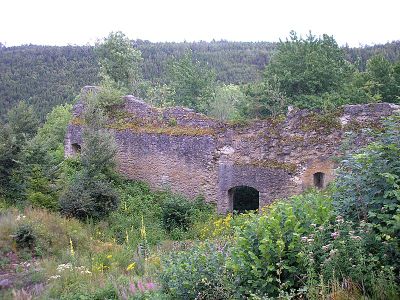
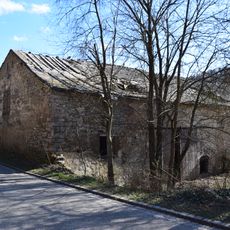
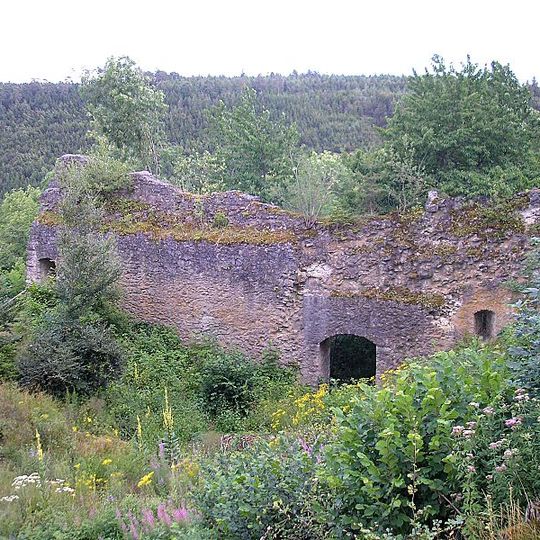
Brunneck Castle is the ruin of a late medieval spur castle on a steep-sided tongue of the Brunnenberg above the Anlauter valley, west of Altdorf in the municipality of Titting. Two stretches of wall survive from the roughly trapezoidal enclosure: a shield-wall-like section about seven metres high, ending to the north in a rounded, tower-like projection, and a wall running at right angles to the slope edge, pierced by a gate opening. A deep neck ditch cuts the site off to the west.
Built at the end of the 14th century by the Lords of Heideck, the castle was sold in 1413 by Johann II of Heideck to the Bishopric of Eichstätt. After 1423 it was enlarged into a episcopal administrative castle under Prince-Bishop Friedrich IV of Oettingen. In 1525 it was occupied and plundered by the Mässing peasant band during the Peasants' War. After 1691 it fell into ruin.
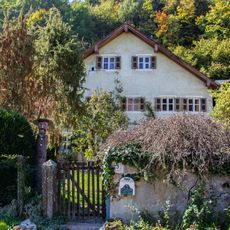
The name Brunneck derives from "Veste Prunnekke", recorded when Johann II von Heideck sold it in 1413. A castle chapel dedicated to Saint Alexius is documented in 1602. The hamlet of Brunneck directly below the ruin counted a single resident in the 1987 census.
The ruin stands on a steep-sided ridge west of Altdorf, above the Anlauter valley; reach it on foot from Altdorf or the Brunneck hamlet. It is open at all times without a fee. Since 2017 a railing secures the wall crown, which can be climbed for 50 metres.
The wall crown was made accessible in August 2017 after the Bavarian State Forests restored the masonry from 2015; a railing now secures a 50-metre walkway on top. Below the ruin stands the Brunneck hamlet, where the 1987 census recorded a single resident.
The community of curious travelers
AroundUs brings together thousands of curated places, local tips, and hidden gems, enriched daily by 94,022 contributors worldwide.