Burg Rothenfels, Historical castle in Rothenfels, Bavaria, Germany.
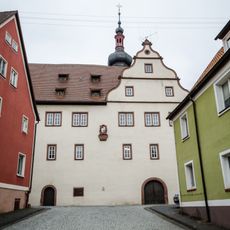
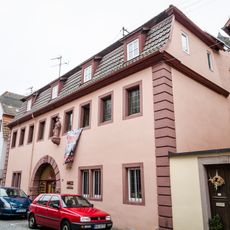
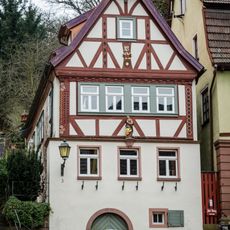
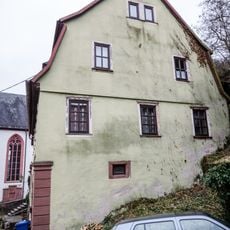
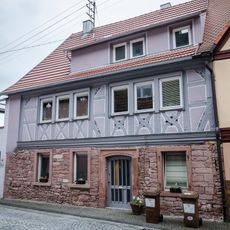
Burg Rothenfels is a fortified structure positioned on elevated terrain with residential buildings, agricultural outbuildings, and planted areas that command views of the surrounding landscape. The buildings and grounds form a cohesive composition adapted to the sloping terrain.
The oldest parts of the castle date from 1150, when Markward II von Grumbach founded it. After the Grumbach line died out in 1243, it passed through marriage to the Counts of Rieneck, who sold it in 1328 to the Wolfskeel family; in 1333 it went to the Bishopric of Würzburg. In 1919 the Löwenstein-Wertheim-Rosenberg princely house sold it to the Quickborn movement, which made it a Christian education centre.
Since 1919 the castle has been a Christian education centre run by the Quickborn movement, later the Vereinigung der Freunde von Burg Rothenfels. Its chapel, shaped under Romano Guardini and builder Rudolf Schwarz, became a centre of the Liturgical Movement. The annual Quickborn days brought young people together for worship, scripture, music and dance.
The grounds are located at Bergrothenfelser Straße 71 and accessible on foot, though the sloping terrain presents elevation changes. Visitors should note that certain areas have limited accessibility and sturdy footwear is helpful for navigating the property.
Burg Rothenfels was the first Jugendburg to emerge from the German youth movement: the Quickborn association bought it from the Prince of Löwenstein on 21 February 1919 and held the first Quickborntag there that August. From 1927 to 1939 the theologian Romano Guardini led the house, and its chapel became a centre of the Liturgical Movement.
The community of curious travelers
AroundUs brings together thousands of curated places, local tips, and hidden gems, enriched daily by 92,619 contributors worldwide.