Egloffstein Castle, Medieval castle in Egloffstein, Germany
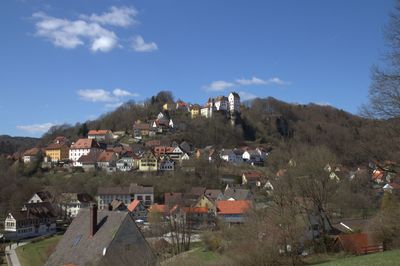
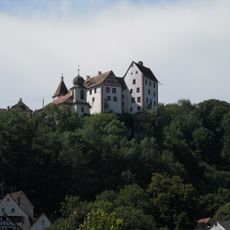
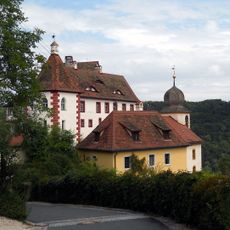
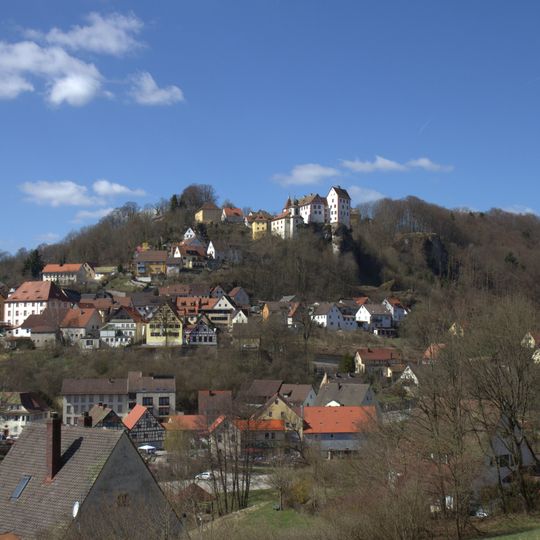
Schloss Egloffstein is a stone castle perched on a hilltop in Franconian Switzerland with commanding views of the surrounding valley. The complex comprises defensive walls, towers, and residential chambers arranged in an integrated layout.
The lords of Egloffstein are documented from 1180, and the castle was first mentioned in 1358, when Albert II of Egloffstein and his brothers founded a chaplaincy there; it is probably older. In 1376 the Bishop of Bamberg forced Seybot II to grant him the right to open the castle. In 1450 troops of Margrave Albert Achilles attacked it unsuccessfully but badly damaged it, and it was considerably remodelled from 1482 to 1493.
The name Egloffstein belongs to the family documented from 1180, who still own the castle and have held Kunreuth Castle since the 14th century. In 1358 Albert II and his brothers founded a chaplaincy here; the castle chapel was replaced in 1750 by the parish church of St. Bartholomew, built by Albert Christopher Charles and Louis I of Egloffstein where the lower kemenate stood.
The castle stands about 80 metres above the village of Egloffstein in the Trubach valley, on a rocky promontory of the Rabenstein at 443 metres, reached on foot from the village. Entry is subject to an entrance fee. The site lies within the Franconian Switzerland-Veldenstein Forest Nature Park, and only the upper ward survives, so the visit is short.
The castle stands on a rocky promontory of the Rabenstein, about 80 metres above the village in the Trubach valley. The name Egloffstein is first recorded for the family in 1180, while the castle itself appears in 1358 when Albert II and his brothers founded a chaplaincy there. The oldest parts may date to the 12th century.
The community of curious travelers
AroundUs brings together thousands of curated places, local tips, and hidden gems, enriched daily by 92,690 contributors worldwide.