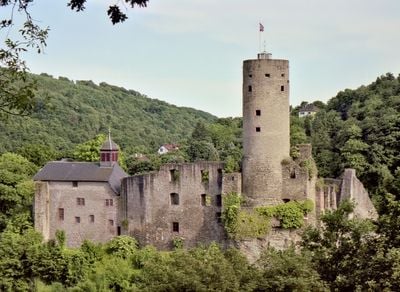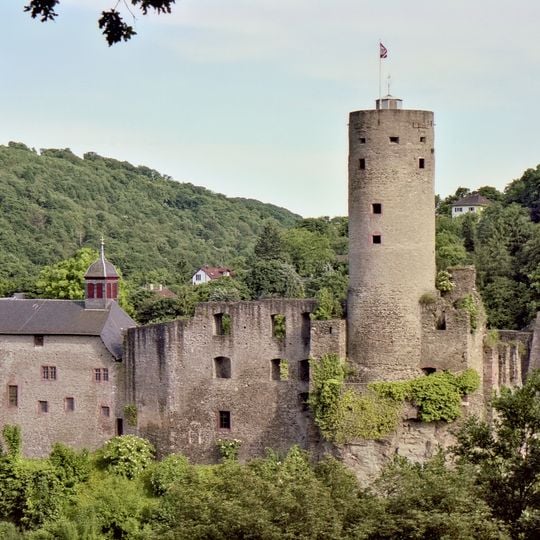
Burg Eppstein, Medieval castle ruins in Eppstein, Germany.
Burg Eppstein is a medieval castle situated on a hilltop, featuring defensive walls, towers, and structures representing different construction periods across several centuries. The site displays multiple architectural styles that developed over time while serving its purpose as a stronghold.
Archaeological finds around the hall date the castle's foundation to the 10th century; it was built as an imperial castle to guard a border and first appears in a document in 1122. Two years later Emperor Henry V gave half to the Archbishopric of Mainz, which soon acquired the other half. Around 1200 the castle passed as a fief to the Lords of Hainhausen, who renamed themselves Lords of Eppstein. In 1492 financial difficulties forced the sale of the western half to Hesse, and in 1581 the eastern half fell to Mainz.
The best-preserved building, the Mainzer Schloss in the east, has housed a museum since 1826. The Eppsteiner Burgfestspiele have been held among the ruins once a year since 1913. The rebuilt Kemenate, the former women's chamber, is rented for exhibitions and used by Eppstein and Kelkheim as a wedding venue.
The castle has two entrances: the main gate in the west is reached by a steep path, while the eastern entrance crosses a bridge over the neck ditch. The best-preserved building in the east, the Mainzer Schloss, has served as a museum since 1826. The kemenate, refitted with a new roof and windows, can be rented for exhibitions and is used by Eppstein and Kelkheim as a wedding venue.
The only fully preserved building is the Mainzer Schloss in the east, built by Electoral Mainz, which had a chapel from 1765. Because that chapel was still in use until 1903, the building escaped demolition as a quarry. Since 1826 the best-preserved building has served as a museum.
The community of curious travelers
AroundUs brings together thousands of curated places, local tips, and hidden gems, enriched daily by 92,637 contributors worldwide.