Burg Gamburg, Medieval castle in Werbach, Germany.
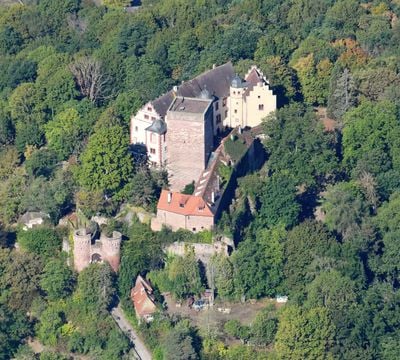
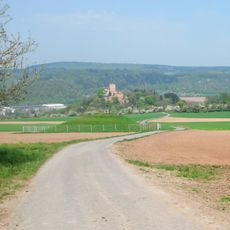
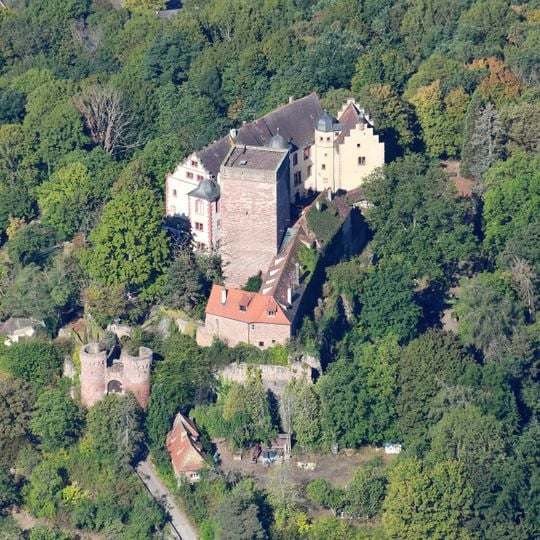
Burg Gamburg stands on a wooded slope above the Tauber, a complex of pale plastered walls and dark tiled roofs. At its centre rises a tall square bergfried with a steep hipped roof and a small round corner turret; lower wings with red-framed windows and round stair turrets adjoin it, and a building with crow-stepped gables links to the right. Below, two round stone towers flank an arched gate.
The castle was built in the mid-12th century by the Archbishops of Mainz and first mentioned in 1157 as "castrum Gamburc", when Archbishop Arnold von Selenhofen granted it as a fief to the noble Beringer von Gamburg. The Lords of Gamburg died out in 1219, after which the castle was occupied by castle men. In 1546 Eberhard Rüdt von Collenberg acquired it from the Archbishop of Mainz by exchange, and it has been privately owned and inhabited ever since.
The hall is the Palas, not a Knight's Hall. Its late-Romanesque wall paintings, uncovered in 1986, are among the oldest surviving secular murals north of the Alps. They were made before 1219, carry Latin and German inscriptions, and show scenes from the Third Crusade of Frederick Barbarossa. Beringer the Younger of Gamburg, who joined the crusade, is considered their patron.
The castle is accessible on foot from the valley below and visitors should expect uneven paths and stairs. Guided tours operate on specific weekends and provide access to interior spaces and the surrounding gardens.
During the German Peasants' War the castle was spared destruction thanks to the personal intervention of Götz von Berlichingen, and it has never been destroyed and has been inhabited at all times. The painter Joseph Archer Crowe died at the castle in 1896.
The community of curious travelers
AroundUs brings together thousands of curated places, local tips, and hidden gems, enriched daily by 92,799 contributors worldwide.