Abenberg Castle, Medieval castle in Abenberg, Germany
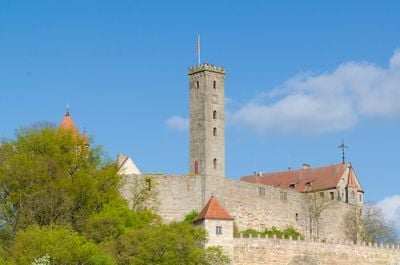
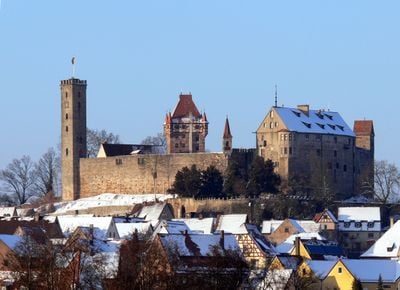
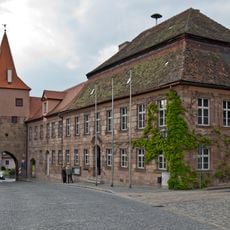
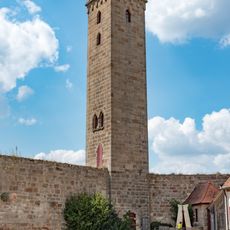
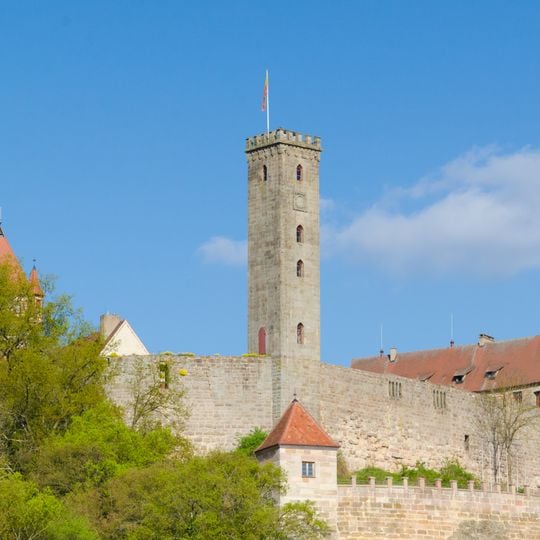
Abenberg Castle is a hilltop complex whose oldest surviving element is the ring wall built between 1230 and 1250, when the main castle was doubled in size. A 33-metre tower, the Luginsland, was rebuilt in the 1870s, and the grounds now hold a restaurant, a hotel, a conference centre, the House of Franconian History and the Bobbin Lace Museum.
Count Adalbert II of the Abenberg family built the first castle largely of wood in the 11th century. Between 1130 and 1140 Count Rapoto replaced it with a stone castle measuring 40 by 40 metres, whose free-standing residential tower had walls 2.5 metres thick of sandstone ashlars. The male line died out around 1200; in 1236 the castle passed by marriage to the Hohenzollern burgraves of Nuremberg, who doubled the main castle between 1230 and 1250 and built the ring wall that is its oldest surviving part. In 1296 it was sold to the prince-bishopric of Eichstätt.
The castle holds the Klöppel museum, opened in 2001, and the Haus fränkischer Geschichte; the lace museum is the only one of its kind in Bavaria. Summer concerts and the Feuertanz festival take place on the grounds, and the castle also hosts wedding ceremonies. The 33-metre Luginsland tower was rebuilt by the Munich art dealer K. J. Zwerschina after 1875.
Visitors should be prepared for stairs and uneven surfaces since the castle sits on elevated ground. The combination of museums, overnight accommodation, and dining options means you can easily spend several hours or a full day exploring the site.
South of the main castle lies a meadow that Wolfram von Eschenbach calls "anger ze abenberc" in Parzival, complaining about its poor condition. It is the only tournament meadow documented at a Bavarian castle. The comic album "Die Ritter von Königsfeld" (1965) used the castle as a model after Jean Graton stayed two days to take photographs.
The community of curious travelers
AroundUs brings together thousands of curated places, local tips, and hidden gems, enriched daily by 92,829 contributors worldwide.