Burg Stolpe, Medieval tower in Angermünde, Germany.
Burg Stolpe is a massive defensive tower in Angermünde with an exterior diameter of approximately 18 meters and ranks among the largest surviving residential towers of its kind in Germany. The structure features multiple stacked chambers, including a vaulted hall with a ribbed dome and a central opening that remains visible throughout the interior spaces.
A Slavic rampart of the 7th/8th century stood here first; eight graves, two of them princely, from the first half of the 12th century were found in 2012 after a badger burrow was noticed. In 1147 the Ukranen came under Pomeranian rule during the Wendish Crusade, and in 1184 Pomerania fell into the sphere of the Danish king Knut VI, who built a tower castle inside the Slavic rampart. Around 1250 the southern Uckermark passed to the Ascanians, and the castle became the seat of the Brandenburg margraves' vogt.
Locals call the tower Grützpott, after a legend; the name is not recorded in medieval documents. Inside, the octagonal chamber holds four niches: one served as a light slit, one for a fireplace, one as a latrine, and the fourth, probably a guard niche, looked out over the trade route west of the castle.
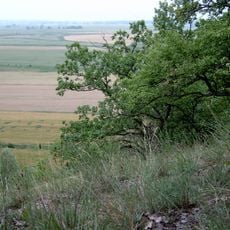
The tower stands on a hill above Stolpe, about 15 km southeast of Angermünde's centre. Only the residential tower and the surrounding ramparts survive; the original entrance was a high doorway about 10 m up, reached by a leaning ladder. In the 19th century Christian Leopold von Buch had a gently rising tunnel cut into the lower chamber.
The tower's nickname Grützpott comes from a local legend, and its interior is octagonal with four niches: one served as a light slit, one as a fireplace, one as a latrine, and the fourth's purpose is still unknown. Experts suspect it was a watch niche overlooking the trade route west of the castle.
The community of curious travelers
AroundUs brings together thousands of curated places, local tips, and hidden gems, enriched daily by 92,634 contributors worldwide.