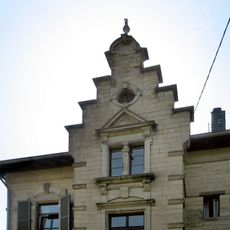
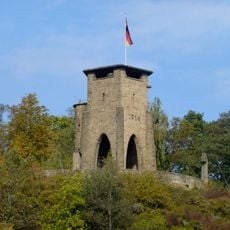
Burg Grumbach, Medieval castle in Grumbach, Germany.
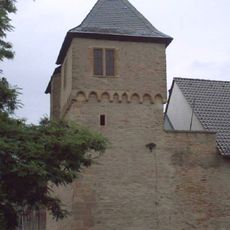
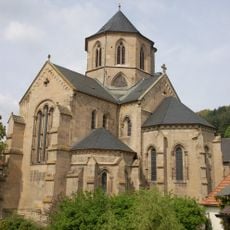
Burg Grumbach is the ruin of a spur castle on a hill spur in Grumbach, Kusel district. Of the former complex only the office building (Amtshaus) and the foundation walls remain; the only fully preserved part of the core castle is the basement storey of the former residential building. Since 1838–1842 a Protestant parish church has stood on the castle site.
Burg Grumbach was first mentioned in 1242, when Wildgraf Konrad von Kyrburg, its probable builder, enfeoffed it to the Duke of Brabant. The Wild- and Rheingrafen inherited it in 1350 and 1409 and held it until 1792, when the counts fled the advancing French. Plundered and used as a military hospital during the coalition wars, the castle was demolished in 1798; a Protestant parish church was built on the site in 1838–1842.
The name Grumbach comes from the counts who ruled here: from 1575 to 1792 the castle, rebuilt as a palace, was the residence of the Wild- and Rheingrafen of Grumbach. In 1556 the Reformation was introduced in Dhaun-Grumbach, and the counts ranked among the Protestant princes who defended the "pure doctrine" at the 1548 Diet of Augsburg. The settlement at the foot of the castle grew out of the original stronghold.
Of the former castle only the basement of the residential building, the Amtshaus and foundation walls remain; the site lies on a hill spur above Grumbach. An Evangelical parish church was built on the castle spot in 1838–1842, so the remains are seen together with the church. The grounds are a Kulturdenkmal and should be visited on foot from the village.
The only fully surviving part of the medieval core is the basement level of the former residential building; the Amtshaus and foundation walls also remain. The parish church built on the castle site between 1838 and 1842 stands where the main castle once rose.
The community of curious travelers
AroundUs brings together thousands of curated places, local tips, and hidden gems, enriched daily by 94,069 contributors worldwide.