Harburg Castle, Medieval fortress in Harburg, Germany
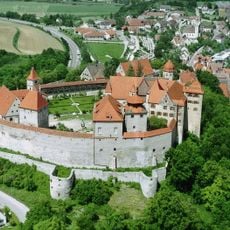
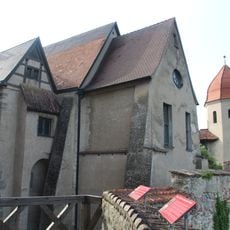
Harburg Castle is a fortification on a rocky spur above the Wörnitz valley with multiple courtyards and a tall central tower. The structure combines architectural elements from Romanesque, Gothic, Renaissance, and Baroque periods added during different construction phases.
Harburg Castle is first documented in 1150, when the 13-year-old Staufer co-king Henry Berengar wrote from it to Constantinople about the Battle of Flochberg; the name Cuno de Horburc appears around 1100. In 1299 King Albert I pledged the castle to the Counts of Oettingen, whose ownership Emperor Sigismund confirmed in 1418. After the Protestant Oettingen-Oettingen line died out, it passed to the Catholic Oettingen-Wallerstein line in 1731.
The castle's name derives from the Middle High German "Horburc", linked to Cuno de Horburc, who is documented around 1100 as its owner. The site is a stop on the Romantic Road, and the lower gate was reached by a drawbridge until a stone bridge replaced it in 1807. The painter Carl Spitzweg is said to have sketched the Red Stabels in the outer bailey during an 1858 visit.
The best time to visit is between March and November when the castle is open to tourists. Guided tours in German and English help visitors understand the different building sections and their original functions.
The castle's late-medieval ring wall with its defensive corridor is unusually well preserved. Three gates lead inside: the Lower Gate once had a drawbridge, replaced since 1807 by a stone bridge over the moat, and the Upper Gate kept a portcullis raised and lowered by chains in two side guides.
The community of curious travelers
AroundUs brings together thousands of curated places, local tips, and hidden gems, enriched daily by 92,893 contributors worldwide.