Lichtenstein Castle, Medieval castle ruin near Pommelsbrunn, Germany.
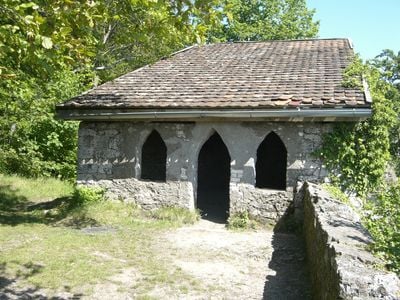
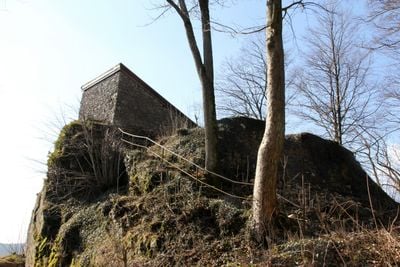
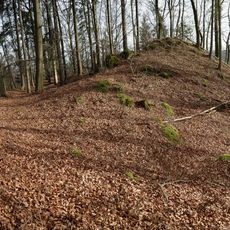
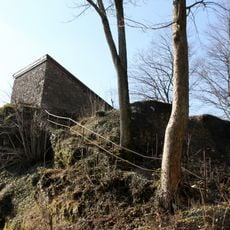
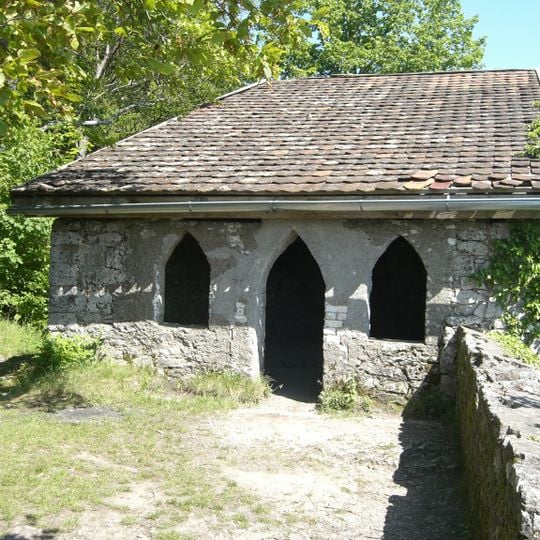
Burgruine Lichtenstein is a ruined hilltop castle on a spur of the Schleußberg at 507 metres above sea level, about 1,080 metres northwest of Sankt Lorenz church in Pommelsbrunn. Its medieval remains, especially those of the lower bailey, are overgrown and at risk of collapse. Around 1855 a pseudo-ruin was built on the upper bailey using standing masonry, and an English landscape garden was laid out in the lower bailey.
Lichtenstein Castle was first recorded in 1270 through a ministerialis named Heinrich von Lichtenstein. In 1349 it passed to the Wittelsbach counts palatine, and in 1353 it was pledged to King Charles IV, who installed a Bohemian administrative office there. In June 1421, during the Bavarian War, it was captured and destroyed. By 1503 it was described as an old broken castle, and in 1851 the Bavarian state sold it to Paul Wilhelm Freiherr Ebner von Eschenbach, who built a sham ruin on the upper ward around 1855.
The name Lichtenstein comes from the ministerial family Heinrich von Lichtenstein, first recorded in 1270; Agnes Lichtensteinerin appears in 1297. The family served the empire and was linked to the Schenken von Reicheneck. Around 1855 Paul Wilhelm Freiherr Ebner von Eschenbach built a pseudo-ruin on the upper castle using standing masonry, and laid out an English landscape garden in the lower castle area, now overgrown.
The ruin sits at 507 metres above sea level on a slope spur of the Schleußberg, about 1,080 metres northwest of Sankt Lorenz church in Pommelsbrunn. It is freely accessible and serves as a viewpoint over the Pegnitz and Högenbach valleys. Several hiking trails lead up from Pommelsbrunn and the surrounding area. The medieval remains, especially those of the lower castle, are badly threatened by decay.
The castle was pledged in 1353 to Charles IV, King of Germany and Bohemia, who set up a New Bohemian administrative office here. Its garrison comprised a caretaker, two mounted soldiers, four watchmen, six foot soldiers, a tower watchman and a gatekeeper. In 1373 Charles sold the castle to the Bavarian dukes to help fund his purchase of the March of Brandenburg.
The community of curious travelers
AroundUs brings together thousands of curated places, local tips, and hidden gems, enriched daily by 92,763 contributors worldwide.