Burg Heinsberg, Medieval castle in Heinsberg, Germany
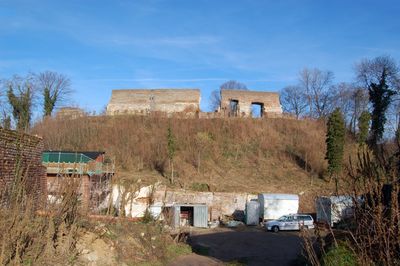
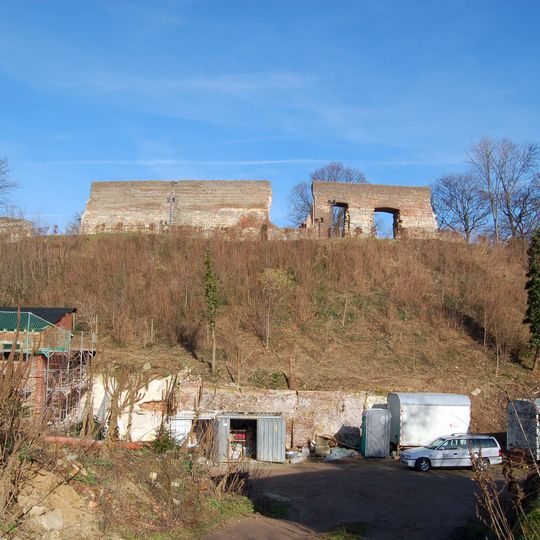
Burg Heinsberg is the ruin of a motte-and-bailey castle on a roughly 10-metre-high artificial hill in Heinsberg, North Rhine-Westphalia. The site was divided by two cuttings into a castle hill and a church hill, the latter carrying the Gothic St. Gangolf collegiate church. Only low masonry remains of the castle survive, along with traces of the town wall and the 16th-century bastioned fortifications.
The castle was probably founded in the 11th century as the seat of the Lords of Heinsberg, initially a timber-and-earth motte. After Heinrich von Limburg destroyed castle and settlement in 1144 on the orders of King Conrad III, it was rebuilt in stone during the 12th century, using limestone, tuff, marl and sandstone. From 1484 it housed a Jülich bailiff; in 1538 work began on a bastioned fortress, and imperial troops took and partly destroyed Heinsberg in 1543.
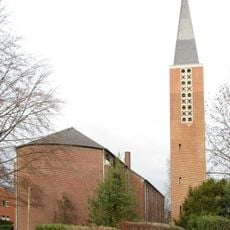
The name Heinsberg survives in the town and in the double hill of Burgberg and Kirchberg, where the outer bailey became the site of the Gothic St. Gangolf collegiate church in the 15th century. The church, not the ruined castle, is the standing monument that recalls the former lordship.
The castle can be reached by regional buses from Heinsberg central station, which connects to surrounding towns and cities. Check current opening times before your visit to ensure access and plan accordingly.
The site is one of the largest surviving motte-and-bailey complexes in the Rhineland: a natural spur above the Rur valley was cut twice, and its tip raised into a main mound about 10 metres high. The neighbouring Kirchberg, the former outer bailey, carries the Gothic St. Gangolf collegiate church built in the 15th century.
The community of curious travelers
AroundUs brings together thousands of curated places, local tips, and hidden gems, enriched daily by 94,346 contributors worldwide.