Burg Lede, Water castle in Vilich, Bonn, Germany
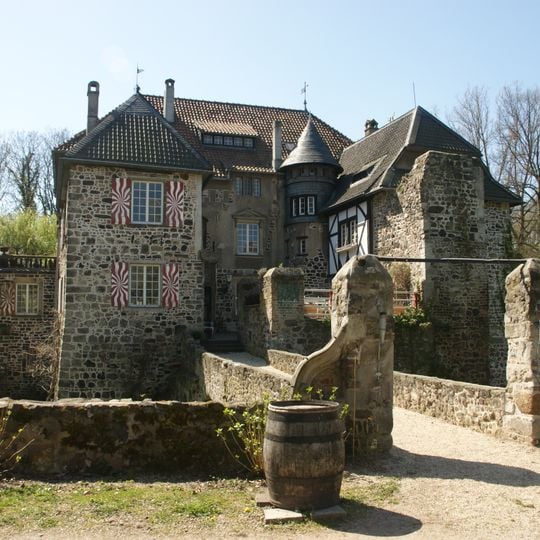
Burg Lede is a water castle in the Beuel district of Bonn, built from rubble stone, basalt, and trachyte, with a main castle section and a connected outer fortification. A moat encircles the entire complex, and a small bridge leads across it to the inner courtyard.
Burg Lede began as a Romanesque residential tower first documented in the 14th century. In 1360, Knight Johann Schillinck had it expanded into a Gothic castle. Destroyed in the Truchsessian War of 1583, the ruin and estate were bought by Vilich Abbey in 1761. After secularization it passed to Nassau-Usingen, then Berg, then Prussia, which sold it in 1820 to Cologne banker Herstatt. In 1904 industrialist Otto Weinlig rebuilt it as a country estate with an English-style park.
The name "Burg Lede" was coined only in the early 20th century, when the owner rebuilt the castle; it probably derives from "Lehm" (clay), referring to the local soil. Before that the complex was called "Schneckenburg" or "Burg Schneckenberg". Today the ground floor houses the Parrotta Contemporary Art gallery, and the park displays garden sculptures, objects and installations by artists, designers, architects and photographers.
Entry to the inner courtyard goes over a small bridge crossing the moat, which is worth pausing on to take in the overall layout. Viewing the complex from the outside first, before crossing, helps to understand how the different parts relate to each other.
The name "Burg Lede" dates only from the early 20th century, when the owner at the time had the castle rebuilt; it probably derives from "Lehm" (clay), referring to the soil. Before that the complex was called "Schneckenburg" or "Burg Schneckenberg". After 1945 it served the British as headquarters for their commander, later Foreign Secretary Lord Carrington.
The community of curious travelers
AroundUs brings together thousands of curated places, local tips, and hidden gems, enriched daily by 92,698 contributors worldwide.