Burg Lichtenfels, Medieval castle in Dalwigksthal, Germany
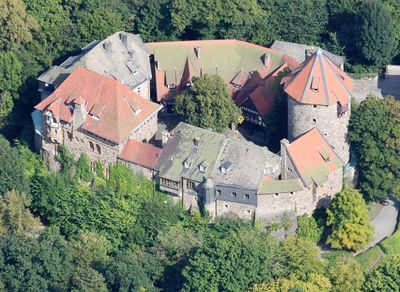
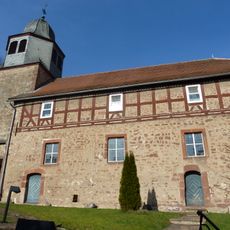
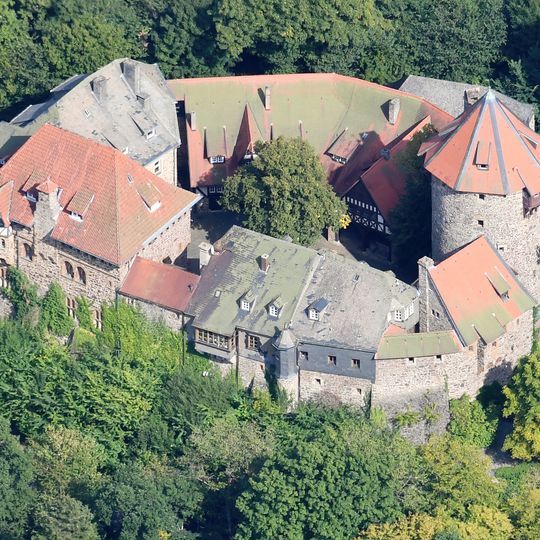
Burg Lichtenfels is a multi-winged stone castle on a 383 m spur of the Eisenberg, about 700 m east-southeast of Dalwigksthal above the Orke valley. Its wings mix pale stone facades with red-tiled hipped roofs and green-roofed sections; a round stone tower with a conical red roof pierced by small dormers stands on the right. A large tree grows in the partly enclosed central courtyard.
The castle was founded in 1189 by the Abbot of Corvey and later destroyed, then rebuilt between 1223 and 1230 under different rule. This reconstruction marked a shift in who controlled the fortress as regional powers changed hands.
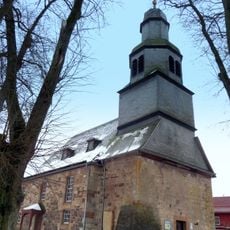
The castle was long the seat of the lords of Dalwigk, vassals of the counts of Waldeck, from 1413. In the Middle Ages a valley settlement with a church belonged to it, recorded as Ensenbecke in 1598 and Eisenbeck in the 14th and late 18th centuries. The present village of Dalwigksthal was only founded in 1851.
The castle stands on a 383 m spur about 700 m east-southeast of Dalwigksthal, above the Orke valley; the approach is through forest. It is a private residence and company headquarters, so the grounds are not open to visitors. Views of the multi-winged complex with its round tower can be had from the surrounding area.
The castle was bought in the late 1980s by entrepreneur Tan Siekmann, founder of Biodata, and his parents, who restored it. Biodata, an IT security firm, was headquartered there until its 2001 bankruptcy; since 2004 the castle has housed Safe-com, again led by Siekmann.
The community of curious travelers
AroundUs brings together thousands of curated places, local tips, and hidden gems, enriched daily by 92,656 contributors worldwide.