Lissberg Castle, Medieval castle in Lißberg, Germany
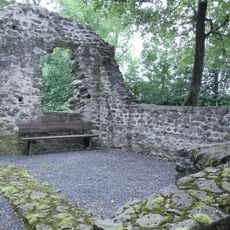
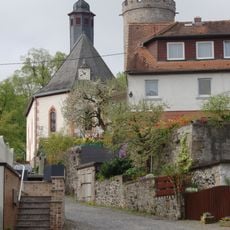
Lissberg Castle is the ruin of a hilltop castle on the summit of a central cone inside an old volcanic crater in the Lißberg district of Ortenberg, Wetteraukreis. Its round bergfried, 27 m high and 9 m in diameter with walls about 3.5 m thick, rises above the site. A shield wall 3 m thick closes the complex to the northeast, and a gate at its southeastern end leads through the zwinger into the wide southern forecourt and then the roughly trapezoidal inner courtyard.
The castle was built in the 12th century by the Lords of Liebesberg, first documented in 1222. Their line died out with Friedrich von Lißberg in 1396; his brother-in-law Johann von Rodenstein took over the castle. In 1415 the counts Johann II and Gottfried IX of Ziegenhain seized it by force and sold half to Landgrave Ludwig I of Hesse in 1418. After the last Count of Ziegenhain died in 1450, castle and office of Lißberg passed wholly to Hesse, and in the 1604 partition they went to Hesse-Darmstadt.
The round bergfried, 27 m high with walls about 3.5 m thick, is nicknamed "das Lißberger Krautfass" (the Lißberg cabbage barrel) because of its conical top. The castle grounds now host medieval markets, private celebrations and tent camps, and the Gemeindesaal of Lißberg stands where the residential building collapsed around 1824.
The grounds are accessible from Ortenberg via marked pathways with informational panels about the layout and history. Visitors should wear comfortable shoes as the uneven terrain requires stable footing.
The round bergfried, nicknamed "Lißberger Krautfass", is 27 metres high with walls about 3.5 metres thick. Its original entrance lay 9 metres up and was reached only by a drawbridge from the adjoining residential building. After that building collapsed around 1824, an external staircase was added in 1865.
The community of curious travelers
AroundUs brings together thousands of curated places, local tips, and hidden gems, enriched daily by 93,686 contributors worldwide.