Burg Lüdinghausen, Medieval castle in Lüdinghausen, Germany.
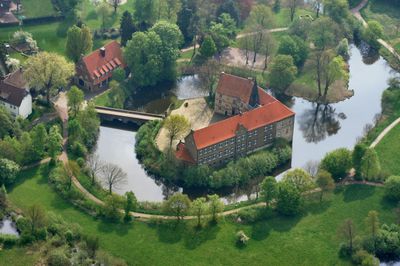
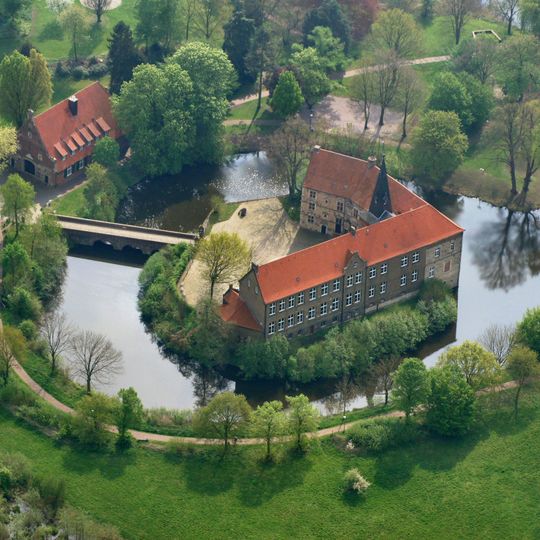
Burg Lüdinghausen is a castle in central Westphalia featuring a main tower and thick walls surrounded by a water-filled moat. The complex comprises several connected buildings that can be reached through bridges and ramps.
The knights of Lüdinghausen, first mentioned in the 12th century, held the castle as a fief of Werden Abbey. After their defeat in 1271 by Bishop Gerhard von der Mark, the castle survived but became an open house of the Bishop of Münster. Gottfried von Raesfeld rebuilt it in Renaissance style between 1569 and 1573 on the old walls; since 2000 it has served as an event centre.
The castle is owned by the town of Lüdinghausen and used for adult education courses, exhibitions and council meetings. Its large hall, decorated with numerous coats of arms, hosts concerts. In 1624 witch trials were held in the court house on the castle, where at least 20 people were executed.
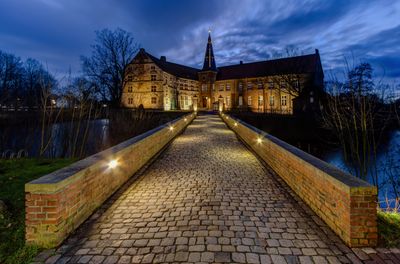
The complex sits on islands ringed by water-filled moats fed by the Stever, so the wings are reached over short stone bridges; the cobblestone bridge in front of the main house is uneven underfoot. The moats and the former keep, about 11 m across, are marked only in the courtyard paving. The grounds are used for walking and cycling, and the upper rooms serve as meeting rooms.
The castle's former bergfried, a tower about 11 metres in diameter, was demolished in 1829; its outline is marked in the paving of the inner courtyard, so visitors can stand where it stood. In the facade, a list of food prices from 1573/74 is carved in stone, alongside coats of arms and an inscription recalling the town fire of 1569.
The community of curious travelers
AroundUs brings together thousands of curated places, local tips, and hidden gems, enriched daily by 92,791 contributors worldwide.