Osterburg, Medieval castle ruin and archaeological site in Bischofsheim an der Rhön, Germany.
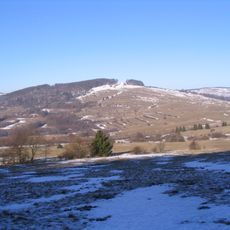
Osterburg is a ruined hilltop castle on the 714-meter Osterburg mountain west of Bischofsheim an der Rhön. Its Romanesque ground plan, uncovered in 1897, measures 114 by 70 meters; stairs and wall remnants remain, and the forest has overgrown the former castle area.
A Reinhold von der Osterburg was mentioned around 1200, and an Engelhard von Osterburg appeared as a witness in charters of 1217 and 1230. In 1231 Boto von Eberstein held a farm at the castle as a fief. Its owners feuded with Abbot Bertho II of Fulda, and the castle was probably destroyed around 1270 when the abbot razed Bischofsheim. By 1600 it was recorded as a rubble heap.
The name refers to its position at the eastern boundary of medieval territory in the region. Today the ruins reveal how people in the Middle Ages built and lived in fortified places on mountainsides.
The ruin lies on the 714-metre summit of the Osterburg hill west of Bischofsheim an der Rhön, reached on foot through forest; there is no road to the top. The wall remains were uncovered in 1897 and measure about 114 by 70 metres in plan. The former bergfried, rebuilt as a viewing tower in 1909, was later demolished because climbing it had become unsafe, so visitors view the site from ground level.
The 1897 discovery of the walls happened during the construction of a timber hauling road; forester Fuchs then had the purely Romanesque ground plan uncovered, measuring 114 by 70 metres. The site was large enough for three to four knights to live in separate courtyards within the ring. Finds from the excavations are kept in the Osterburg collection in Bischofsheim.
The community of curious travelers
AroundUs brings together thousands of curated places, local tips, and hidden gems, enriched daily by 92,883 contributors worldwide.