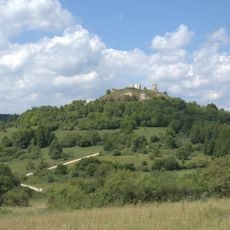
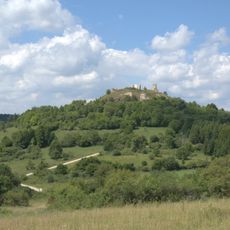
Burgruine Roßstein, Medieval castle ruin in Hohenburg, Germany.
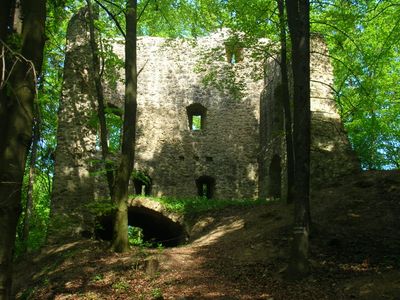
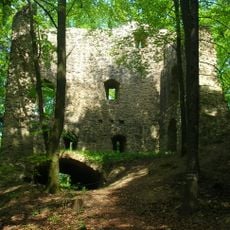
Burgruine Roßstein is a ruined spur castle on a rock spur at 453 m above sea level, with steep drops on three sides and a deep neck ditch cut into the rock to the south, fronted by two stone ramparts. The surviving residential tower (Palas) has three storeys, a barrel-vaulted cellar in its west part, a first-floor door opening to an oriel on the north side, and a 1.6 m thick windowless south wall of the eastern annex that resembles a shield wall. The masonry is dolomite rubble with lime mortar and quoins, with some bossed ashlar suggesting a Romanesque predecessor; only the tower ruin and wall remnants of the main castle remain, while the outer bailey is marked by ramparts and ditches.
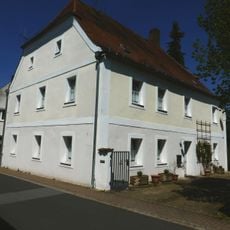
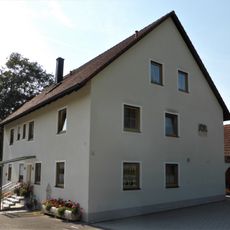
The castle was probably built before 1331 by Konrad Erlheimer, who named himself after Roßstein from that year. In 1411 Regensburg forces burned it during a feud with the Punzinger family, and Andreas Punzinger had to renew it. After 1490 it passed to the Palatinate, burned down through negligence in 1550, and from 1563 Lienhard Spieß used it as a quarry for building Spieshof.
The castle's name comes from Old High German 'hros', meaning horses, which later became Middle High German 'ros' for knights' warhorses. This naming choice reflects how the fortress was tied to cavalry and medieval warfare.
The ruins are freely accessible and can be reached by parking at Spießhof and following marked trails through the forest. Wear suitable footwear as the paths are uneven and access involves crossing rocky ground.
The walls of the residential tower still show beam holes marking three storeys, and on the north side a first-floor doorway led out to an oriel. The south facade is entirely gone, while the east annex rises directly above the moat with a windowless 1.6 m wall.
The community of curious travelers
AroundUs brings together thousands of curated places, local tips, and hidden gems, enriched daily by 94,368 contributors worldwide.