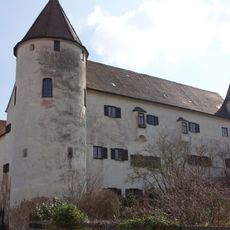
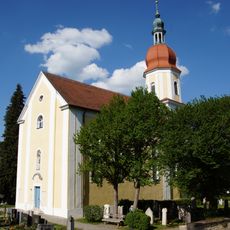
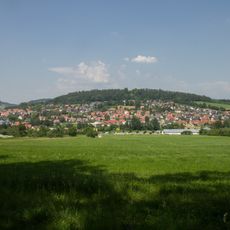
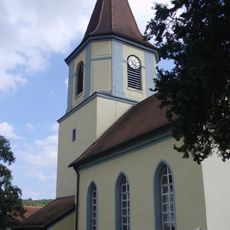
Burgruine Stauf, Castle ruin in Thalmässing, Germany.
Burgruine Stauf occupies a long oval plateau on the 535-metre Burgberg above the village of Stauf. The keep survives only as a 7 × 6 m stump of smooth ashlar with putlog holes, its 1.50 m walls doubled on the eastern attack side. Thirteen metres west stand the ruins of the square palas faced with bossed ashlar, its east wall built into a house.
The lords of Stauf appear in documents from 1138; the castle itself is first named in 1276, when Hermann von Stauf held it as a fief of Ludwig II, Duke of Bavaria. Around 1309 Emperor Henry VII destroyed it in his war against Count Eberhard of Württemberg. Rebuilding permission was granted in 1328 and again in 1355, and the castle was restored by 1366. Duke Ludwig the Rich of Bavaria destroyed it in 1460 during his conflict with Margrave Albrecht Achilles, after which it stayed in ruins.
The name Stauf comes from the noble family of the Herren von Stauf, documented from 1138, who held the castle as a fief of the Counts Palatine of the Rhine. The ruin is privately owned by the descendants of Josef Drexel and cannot be visited; the village of Stauf below it grew from the administrative seat that moved downhill after 1460.
Burgruine Stauf stands on the 535-metre Burgberg above the village of Stauf, and the ruin itself is privately owned and cannot be visited. The site is recorded as a Bodendenkmal (D-5-6833-0221), so the plateau and its remains are seen from outside or from the surrounding paths rather than entered.
The castle cannot be visited: it has remained in private ownership since 1909, when the Miehling family bought the land, and later passed to Josef Drexel, whose descendants still own it. The keep survives only as a stump, 7 by 6 metres, with walls 1.50 metres thick that double on the eastern attack side.
The community of curious travelers
AroundUs brings together thousands of curated places, local tips, and hidden gems, enriched daily by 92,644 contributors worldwide.