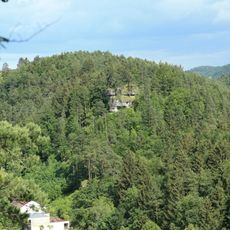
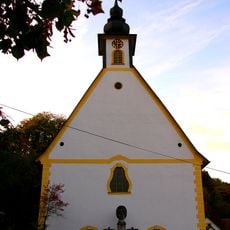
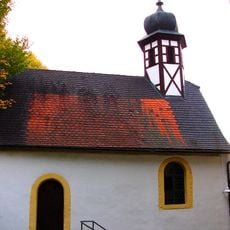
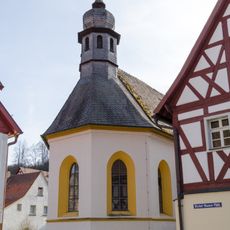
Baudenkmal, Castle ruin in Waischenfeld, Germany
Baudenkmal is a castle ruin located on a hilltop in Waischenfeld featuring preserved medieval wall sections and a gate structure. The remains display different phases of fortification with visible stone constructions distributed across the site.
A castle at Waischenfeld was first recorded in 1122 as "Urbs"; the family of Wirint von Waischenfeld, documented in 1079, died out with Ulrich von Waischenfeld, and after 1216 the castle passed to Eberhard III of Greifenstein. In 1348 it came to the Bishopric of Bamberg. Hussite troops damaged it in 1430, and in the Second Margrave War margrave's troops took it three times and burned it on 7 June 1553. From about 1600 it served as a grain store; the ruins were demolished in 1876/77 and 1889.
The structure displays medieval building techniques through its preserved stonework that visitors can still observe today. These remains offer insight into the craftsmanship and construction methods that were common in the region during medieval times.
The site is accessible via Schloßberg street in Waischenfeld with marked paths leading to observation points throughout the ruins. Visitors should wear sturdy footwear as the terrain is uneven and some areas feature steep slopes.
The round tower Steinerner Beutel, about 13 metres high, is the town's landmark and formed the northernmost part of the castle, the Rüssenbach estate. It stands on a limestone crag and was originally a watchtower with an elevated entrance.
The community of curious travelers
AroundUs brings together thousands of curated places, local tips, and hidden gems, enriched daily by 92,698 contributors worldwide.