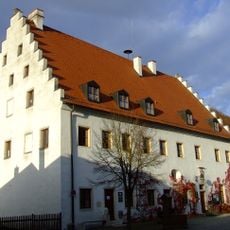
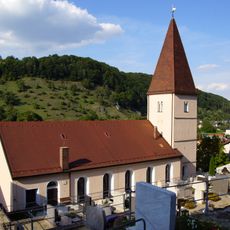
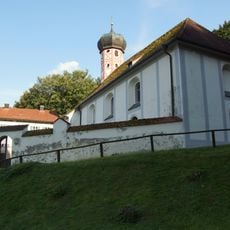
Burg Mörnsheim, castle
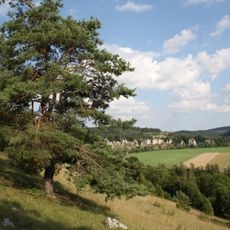
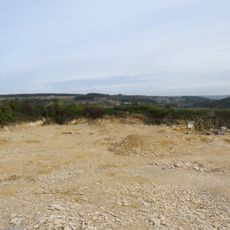
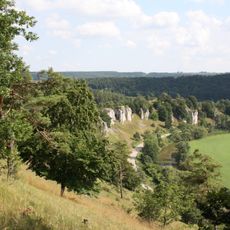
Burg Mörnsheim, also called Staffelburg, is a ruined hilltop castle on the Schloßberg at about 510 m above sea level above the Gailachtal valley in Mörnsheim, Bavaria. The surviving remains include sections of the ring wall and the Zwinger wall, plus a barrel-vaulted room of the castle chapel of St. Afra. The site is recorded as a Bavarian architectural monument and as a buried archaeological monument.
The castle's origins likely go back to the Lords of Mörnsheim in the 10th century; it was first mentioned in 1225, when Bishop Heinrich I. von Zipplingen had a massive keep of buckled ashlar built on the highest point. In 1281 it was called "castrum Mornsheim". Bishops Konrad II. von Pfeffenhausen, Friedrich IV. von Oettingen, Albrecht II. von Hohenrechberg and Johann III. von Eych added walls, a zwinger, a moat and a residential building. After 1634 it decayed and was partly demolished in 1760; consolidation began in 1980.
The name Mörnsheim reflects its origins as an administrative center for the local bishop. The castle shaped how the village below developed and remains a visual landmark that connects people to their past.
The accessible ruins are open to walk around freely at any time without restriction. Free parking is available nearby, and the walk to the castle grounds is very short, with benches and tables at the top where visitors can rest and enjoy the views.
Swedish forces attempted to capture the castle in 1634 during the Thirty Years War but failed, even as the nearby town burned. A scale model showing the castle in its original form can be viewed at Mörnsheim town hall.
The community of curious travelers
AroundUs brings together thousands of curated places, local tips, and hidden gems, enriched daily by 94,463 contributors worldwide.