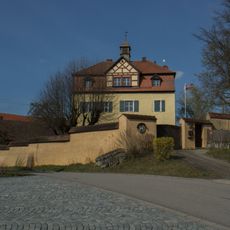
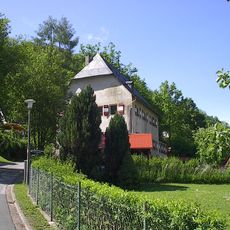
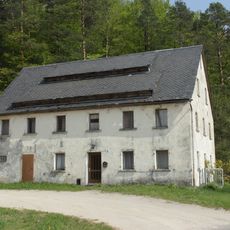
Burgstall Spies, Archaeological heritage site in Betzenstein, Germany.
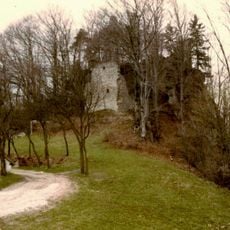
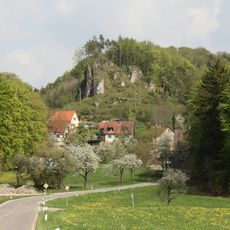
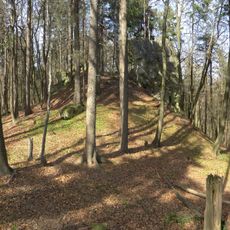
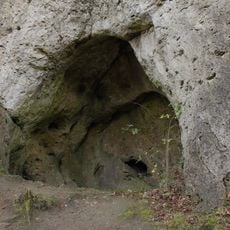
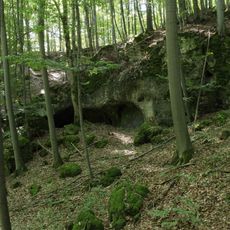
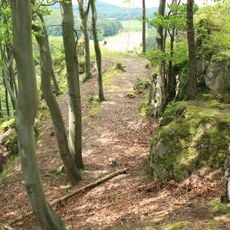
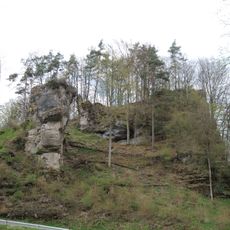
Burgstall Spies is a ruined hilltop castle on the 616.4 m Spieser Schlossberg, a cone-shaped hill rising about 50 m above the village of Spies. A 120 m long, 10–15 m wide rock reef runs north–south along the summit, with three rock towers at its north end. The site comprised an upper castle on the reef, a lower castle to the west and an outer bailey to the south; a neck ditch with outer rampart, about 15 m long, 5 m wide and 1 m deep, survives on the south side, along with two wall remnants.
The name Spies appears in 1187 with Pertholt Spiez; Heinrich Spiez is named in 1189 as a ministerialis of the dukes of Andechs-Meranien. Whether the family built the castle is unknown, and they sold it before 1346. On 23 September 1397 King Wenzel besieged the castle for seven days and took it on the eighth; 22 of the 24 defenders escaped by rope down the cliffs.
The name Spies is documented from 1187, when a "Pertholt Spiez" appears in records; the family died out around 1475. The castle later became a margravial office, administered by pflegers such as Fritz Stör in 1469 and his son Kunz Stör in 1482. Visitors today see only the flattened ditch, outer rampart and two wall remnants on the wooded summit.
The site is reached on foot from the village of Spies by heading north past a playground area. Since the ground sits on an exposed hilltop, wear sturdy shoes and bring clothing suited to open weather conditions.
Of the 24 defenders holding the castle during King Wenzel's siege of 23 September 1397, 22 escaped by lowering themselves down the rocks; only Hans von Aufseß and Georg von Wichsenstein were taken, and Wichsenstein was executed in Nuremberg. The rock face, not a hidden path, was their way out.
The community of curious travelers
AroundUs brings together thousands of curated places, local tips, and hidden gems, enriched daily by 94,644 contributors worldwide.