Burgruine Hilpoltstein, Medieval castle ruin in Hilpoltstein, Germany
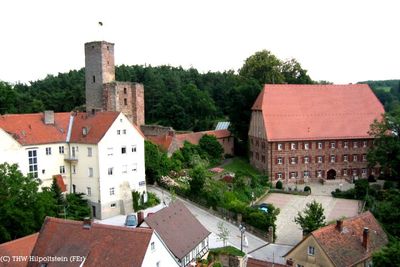
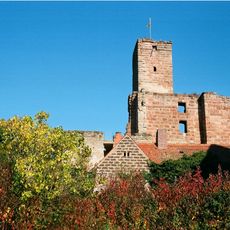
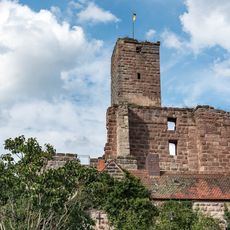
Burgruine Hilpoltstein is a ruined hilltop castle on a sandstone rock, the Burgberg, in Hilpoltstein. Its rectangular core follows the rock's outline with sandstone block walls from the mid-13th century onward. The west side holds the foundations of the Palas, the east the 22-metre-high square bergfried with 1.7-metre-thick walls and a pointed-arch entrance 10 metres up. A southern outer courtyard has a stair tower with a 1606 Renaissance portal.
Archaeological traces of a fortification on the Burgberg date to the 10th century; the castle itself was probably built around 1100 and is recorded in 1109 and 1142, called "castellum dicto Stein" in 1154 after the lords of Stein. Around 1220–1230 the Palas and bergfried were founded, and in 1250 Heinrich von Stein, imperial butler at Nuremberg, enlarged the castle. After Hilpolt IV died in 1385 it passed to the Wittelsbachs, then to Bavaria-Landshut and in 1505 to Pfalz-Neuburg. Duchess Maria Dorothea, widow of Ottheinrich II, lived there from 1606 and extended it; after her death in 1639 it stood empty, was sold to private owners in 1793 and quarried for stone. The district of Roth acquired it in 1972 and secured it from 1989.
The name Hilpoltstein comes from Hilpolt I von Stein, who received the castle from his father Heinrich von Stein. Today the site hosts the medieval festival "Ritter, Barden, Beutelschneider" each May and the Burgfest on the weekend of the first Sunday in August, when the ruin serves as an open-air stage for the Burgtheater in July and August.
The ruins sit on a hill near Hilpoltstein and are reachable from the village. The site is best explored on foot, and it is advisable to wear sturdy shoes since the terrain is uneven.
The entrance to the castle was cut directly into the sandstone rock; behind it, a room led to the inner courtyard first by a wooden ladder and later by a retractable wooden staircase. In the rampart east of the Burganger lies a flat cellar with a barrel vault, built around 1170/80 as the lower floor of a multi-storey defensive structure and later used as a beer cellar.
The community of curious travelers
AroundUs brings together thousands of curated places, local tips, and hidden gems, enriched daily by 94,250 contributors worldwide.