Schloss Truppach, Medieval castle in Mistelgau, Germany
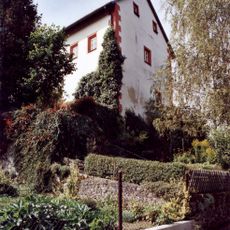
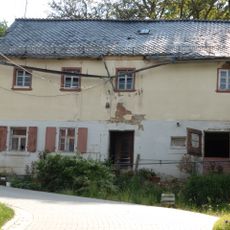
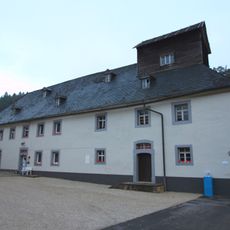
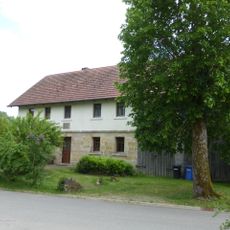
Schloss Truppach is a former water castle in the Mistelgau district of Truppach, built on a lowland site once ringed by a palisade fence and a moat. The multi-storey Palas has massive stone walls on its lowest level with a single window opening on the left, while the upper floors are timber-framed. Small watch turrets sit at each corner of the Palas, and the bergfried in the right half of the complex is reached only by a passage from the Palas.
First documented in 1380 under Conrad the Elder of Christanz, the castle served as a fortified holding in the region until troops of the Swabian League destroyed it in 1523. Reconstruction following this damage transformed it from a purely military stronghold into a residence with defensive features.
The castle's name comes from the Truppach stream, and the family von Truppach, documented from 1059 as "de Trubaha", held a noble seat here from 1380 until the line died out in 1550. The village's second seat belonged to the von Aufseß, who sheltered the robber baron Hans Thomas von Absberg's captives and whose castle was blown up by the Swabian League on 4 July 1523.
The castle remains privately owned and occupied, so visitors should observe all posted access restrictions and respect the privacy of residents at all times. The exterior can be viewed from accessible viewpoints without entering private grounds.
The 1523 woodcut by Hans Wandereisen shows the castle as a lowland water castle ringed by a palisade fence and a moat, with small turrets at the corners of the inner wall and a chapel in the upper left corner. The Swabian League's troops are drawn clearing the site, their flag mistakenly coloured blue-white instead of red-white.
The community of curious travelers
AroundUs brings together thousands of curated places, local tips, and hidden gems, enriched daily by 93,832 contributors worldwide.