Wagegg, Medieval castle in Haldenwang, Germany.
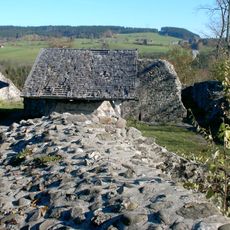
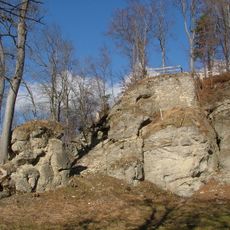
Wagegg is the ruin of a hilltop castle and later baroque palace above the village of Wagegg in Haldenwang, Oberallgäu. Of the complex only a large hill with some wall remains and a large stone gate survive; a fortified path without a railing leads up to a viewing platform reached by steps, and a small cave lies on the east side of the hill.
Burg Wagegg was first mentioned around 1170 and belonged to the Lords of Wagegg until 1374, when it passed to the Prince-Abbey of Kempten. After changing hands several times, it was acquired by the von Laubenberg family in 1469 and taken by peasants in 1525. The abbey bought it back in 1580; after 1581 it decayed, was rebuilt as a hunting lodge from 1642 and expanded into a Baroque palace from 1715. Plundered by the French in 1796, it was sold for demolition in 1807, with the last wing torn down in 1851.
The name Wagegg comes from the lords of Wagegg, ministeriales of the prince-abbey of Kempten who held the seat until 1374. The site later served the prince-abbots of Kempten as a hunting lodge from 1642 and as a baroque palace with gardens and ponds from 1715. A fortified path without a railing now leads up to the ruin.
A fortified path without a railing leads up to the ruin; steps continue to a viewing platform on top. In clear weather the platform gives a wide view of the Allgäu Alps. The site is a hill with a few wall remains and a large stone gate, so wear sturdy shoes.
The ruin includes a small cave on the east side of the hill, and the rock face in the outcrop north of the castle hill is listed by the Bavarian State Office for the Environment as a valuable geotope (number 780A015). A fortified path without a railing leads up to the remains.
The community of curious travelers
AroundUs brings together thousands of curated places, local tips, and hidden gems, enriched daily by 93,848 contributors worldwide.