Böhmischer Gottesacker, Garden monument and cemetery in Neukölln, Germany.
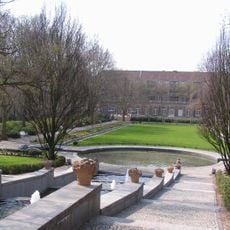
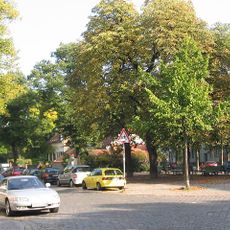
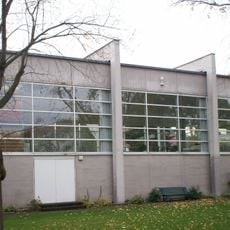
The Böhmischer Gottesacker is a 5,603 m² cemetery laid out in 1751 on Karl-Marx-Platz in Neukölln, geometrically planned around a main avenue lined with linden and chestnut trees. Its three sections belong to the Moravian Brethren, the Reformed Bethlehem congregation and the Lutheran congregation; the Brethren's part is recognisable by uniform, plain recumbent gravestones. A brick chapel with an open porch was built by Erich Ruhtz in 1965/66.
This burial ground was founded in 1751 and ranks among Berlin's oldest active cemeteries. It served Protestant refugees from Bohemia who had settled in the Rixdorf village as their burial place for generations.
The cemetery has been divided since 1903 into three sections for the Moravian Brethren, the Reformed Bethlehem congregation and the Lutheran congregation. The Moravian part is recognizable by its uniform, simple grave design with recumbent stones, laid out in the Brethren's tradition with burials separated by sex. The Lutheran and Reformed sections differ in grave layout and stone forms.
The cemetery lies just off Karl-Marx-Platz in Neukölln, with one gate set into the surrounding housing and a second gate on Kirchhofstraße. A main avenue lined with linden and chestnut trees runs through the geometrically laid-out grounds. There is no grave plan for the burials or the numerous reburials, so visitors orient themselves by the three congregational sections.
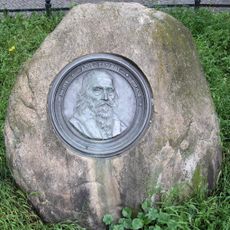
When the Blücherstraße was built in 1971, much of the Moravian cemetery at Hallesches Tor was destroyed; 15 grave slabs were brought to the Ziegelmauer here beforehand. Among the roughly 130 slabs on the eastern wall are some of Berlin's oldest, including that of Bishop Andreas Grasmann and the early settlers Adam Krystek and Jan Pittmann.
The community of curious travelers
AroundUs brings together thousands of curated places, local tips, and hidden gems, enriched daily by 92,708 contributors worldwide.