Bürgerpark Pankow, Public park in Pankow, Germany
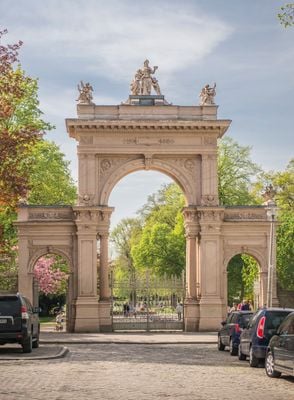
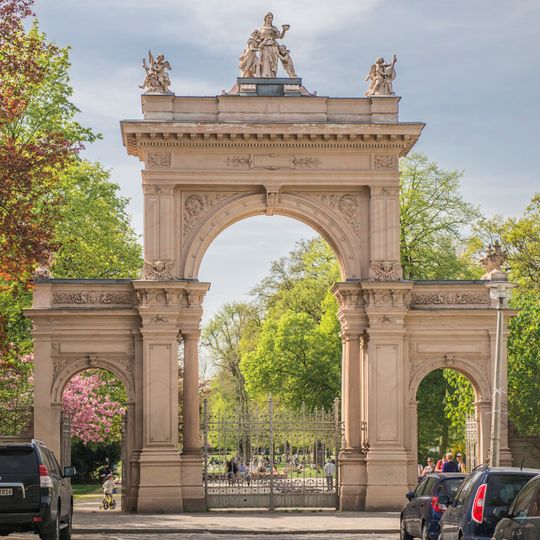
Bürgerpark Pankow is a 12-hectare park along the Panke river, entered through a three-part Neo-Renaissance portal modelled on Italian triumphal arches, with paired columns and three sculpted figures on top. Inside are wide meadows, old oaks, beeches and maples, a rose garden with a sandstone pergola, and a small animal enclosure with dwarf goats.
Hermann Killisch von Horn, founder of the Berliner Börsen-Zeitung, bought the site of a former paper mill in 1856 and had an English-style landscape garden laid out with Wilhelm Perring in 1863–64. The municipality of Pankow purchased the park in 1907 under mayor Wilhelm Kuhr for 1.45 million marks and opened it to the public. The grounds were redesigned in 1965–68 after wartime damage.
The park's name, Bürgerpark, dates from its 1907 opening to the public. In the 1920s a local pharmacist advertised it as a spa park, running a drinks stand with well-known German and European mineral waters. Concerts still take place occasionally in the music pavilion.
The park lies along the Panke between Wollankstraße station and Wilhelm-Kuhr-Straße, where the main entrance stands. Tram M1 and buses 155 and 250 stop at Bürgerpark Pankow; bus 255 stops at Wilhelm-Kuhr-Straße. A footpath follows the river through the grounds, and the rose garden with its sandstone pergola is a short walk from the entrance arch.
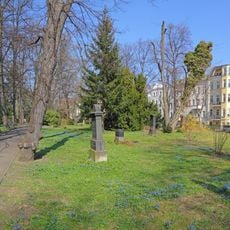
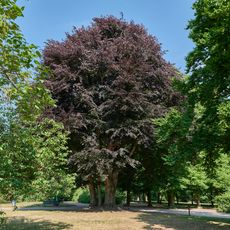
The park's oldest trees date to the mid-19th century, when Hermann Killisch von Horn laid out his estate. Along the Panke bank stands a roughly hundred-year-old swamp cypress (Taxodium distichum) listed as a natural monument, as are an American red oak and a red beech. A mulberry, trumpet tree, tulip tree and sweet chestnut can also be found.
The community of curious travelers
AroundUs brings together thousands of curated places, local tips, and hidden gems, enriched daily by 93,849 contributors worldwide.