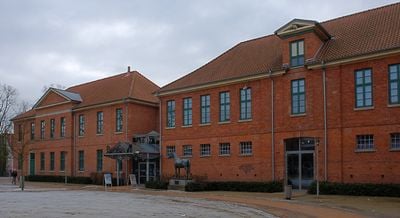
Deutsches Pferdemuseum, Horse museum in Verden, Germany
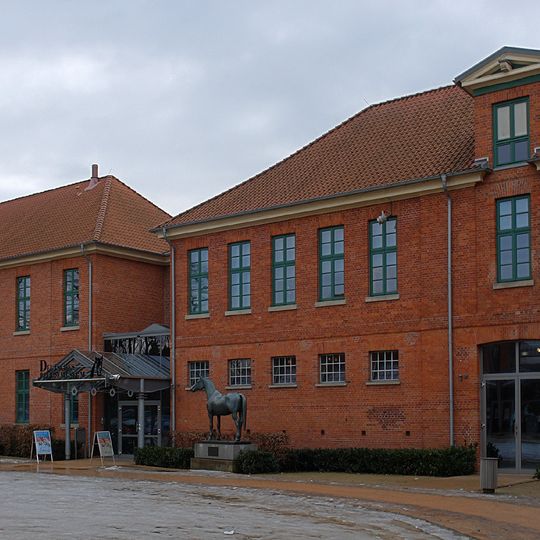
The German Horse Museum is housed in former cavalry barracks near the train station and presents exhibits about horse breeds, equestrian sports, and the history of human-horse relationships. The permanent exhibition uses multiple halls with different topics and additional spaces for rotating special exhibitions.
The collection was begun around 1930 by the Verdener Heimatbund and became an independent institution under the name Deutsches Pferdemuseum in 1965, making it Germany's oldest horse museum. It was first housed in the Boeselager villa, moved to the half-timbered house at Strukturstraße 7 during the Nazi period, and in 2000 relocated to the former cavalry barracks buildings at the Holzmarkt near the station.
The sandstone tablet inscribed "Gaudemus equis" ("let us rejoice in horses") once stood above a doorway in Verden and is now shown on the ground floor, alongside old feeding troughs that recall the town's horse markets. Upstairs, separate sections are devoted to individual horses and riders, among them the counting horse Kluger Hans and the dressage rider Josef Neckermann.
The museum occupies the former stables and troop buildings of the cavalry barracks on the Holzmarkt, right by Verden's train station. The permanent exhibition covers 1400 m² on two floors, with the ground floor devoted to Verden as a horse town and the upper floor to how horses are used; a further 230 m² holds temporary shows.
A stone replica of the famous stallion Tempelhuter has stood at the entrance since 1974, one of the most important breeding stallions in German horse history. This statue has become a landmark of both the museum and the town.
The community of curious travelers
AroundUs brings together thousands of curated places, local tips, and hidden gems, enriched daily by 93,897 contributors worldwide.