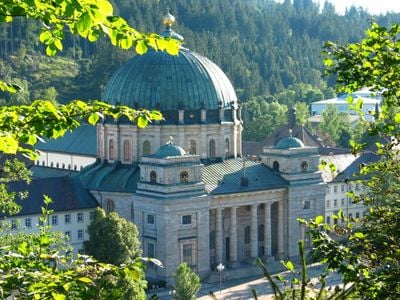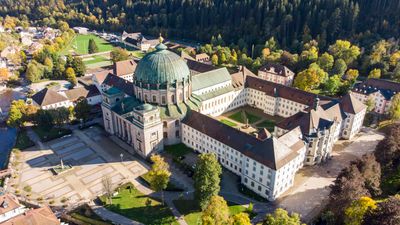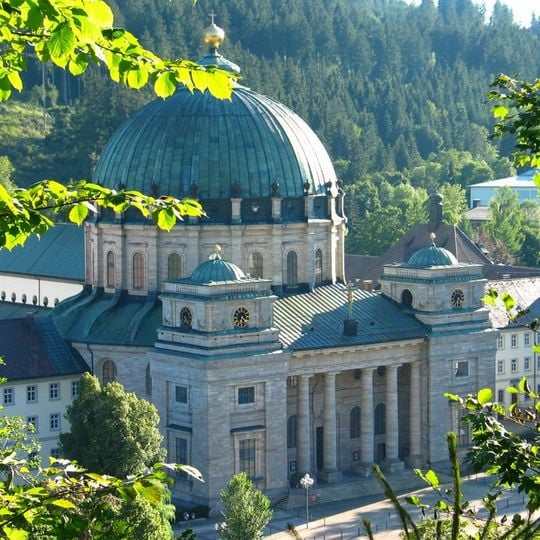
Dom St. Blasien, Abbey church in St. Blasien, Germany.
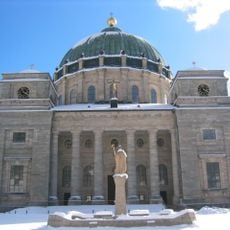
Dom St. Blasien is the former abbey church of the Benedictine monastery, consecrated in 1783 and 62 metres tall. Pierre Michel d'Ixnard modelled the Zopfstil building on the Pantheon in Rome: a rotunda under a green copper dome spanning 36 metres, set on a drum ringed with small windows, with two smaller copper-domed towers flanking the grey stone portico.
The church was built starting in 1768 under architect Pierre Michel d'Ixnard to replace a Benedictine monastery that had been destroyed previously. The construction took decades to complete in its final form, and it has shaped the townscape of St. Blasien ever since.
Locals call it the "Schwarzwälder Dom", though as a former monastery church it should properly be a Münster, not a cathedral seat. The parish of St. Blasius still uses it, and each summer it hosts an international cathedral concert series. Look for the Habsburg tombs: in 1770 Prince Abbot Martin Gerbert had remains of early Habsburgs moved here from Basel Minster and Königsfelden.
The church is entered from the town square through the columned portico; the dome rotunda lies straight ahead, with the long choir behind it. The annual international cathedral concerts take place in summer, so check the parish notice before a visit. The dome collapsed in the 1874 fire and was rebuilt outside between 1878 and 1883.
The dome spans 36 metres, making it one of Europe's widest; when it was consecrated in 1783 the church was Europe's third-largest dome church. Prince Abbot Martin Gerbert had the bones of early Habsburgs moved here from Basel Minster and Königsfelden in 1770, intending St. Blasien as a dynastic burial site. A fire in 1874 made the dome collapse; Baden's grand duke had the outer shell rebuilt between 1878 and 1883.
The community of curious travelers
AroundUs brings together thousands of curated places, local tips, and hidden gems, enriched daily by 92,810 contributors worldwide.