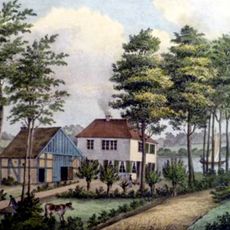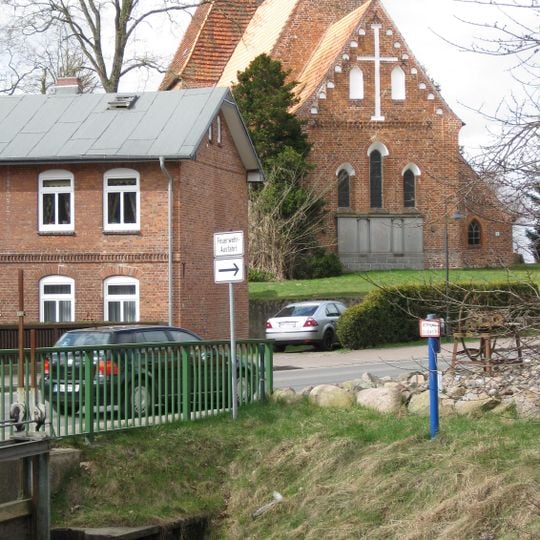
Church in Herrnburg, Brick Gothic church in Lüdersdorf, Germany
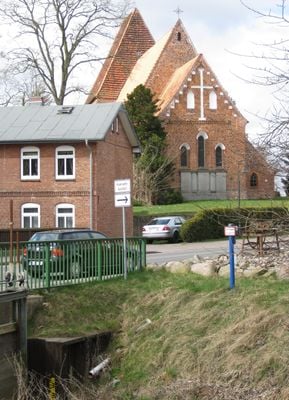
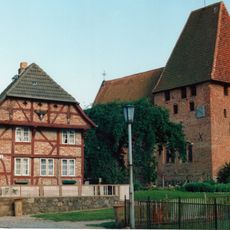
The Church in Herrnburg is a brick structure featuring pointed arches that demonstrate the architectural principles typical of Northern Europe. The building is entirely constructed from red bricks arranged in patterns characteristic of Brick Gothic design.
The square box choir with three east windows dates from the mid-13th century and probably served as a chapel at the customs station. The church is first documented in 1319, while the village of Herrnburg appears in records only in 1399. The nave and north sacristy were added in the late 15th century, and the massive west tower followed in the first half of the 16th century.
The parish area covers Duvennest, Klein and Groß Neuleben, Lenschow, Lüdersdorf, Palingen and Wahrsow, and until 1945 also the Lübeck estate of Brandenbaum. After 1990 new housing raised membership from 500 in 1993 to about 1700 in 2005, so a community centre was built in 2009 between the church and the old parsonage. The church also administers St. Marien in Selmsdorf.
The church stands in Herrnburg's centre, ringed by the parsonage, the Old Customs House, the former water mill, former inn buildings and the fire station. A new community centre was built in 2009 between the church and the old parsonage. The two bells were rung by hand until 2021, when a Lübeck couple donated a third, larger bell cast by Bachert in Neunkirchen and an electric ringing system was installed.
A whale rib hangs from the ceiling of the church, a curiosity often missed by visitors. The organ, built in 1883/84 by Friedrich Albert Mehmel, was restored in 2014 by Reinalt Johannes Klein and has ten registers on two manuals and pedal.
The community of curious travelers
AroundUs brings together thousands of curated places, local tips, and hidden gems, enriched daily by 94,023 contributors worldwide.