Karow church, Medieval church building in Pankow, Germany.
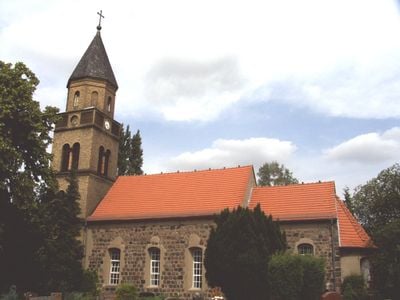
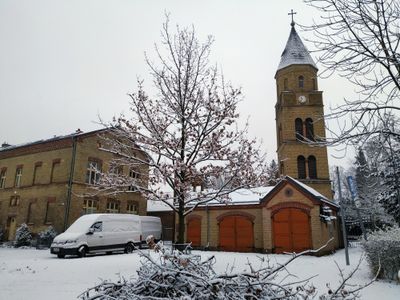
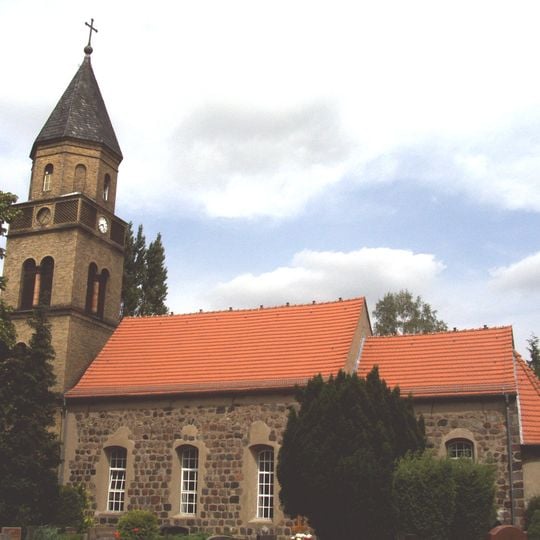
Dorfkirche Karow is a late Romanesque fieldstone church on Alt-Karow in Berlin's Karow district. Its three-part plan of nave, recessed choir and apse is built of carefully hewn fieldstone, with a red-tiled roof and three tall arched windows in the nave wall. A square tower with a pointed spire and clock stands beside the west front, joined to the nave by a short intermediate structure.
Built around 1240–1260 as a three-part apse church of carefully hewn fieldstone, Karow's church is the oldest village church on the Berlin part of the Barnim. It was vaulted and painted in 1429, restored in 1622 and 1792–1795, and given flat barrel ceilings in 1830. Friedrich August Stüler added the yellow-brick tower in 1845–1847, linked to the nave by a short intermediate structure.
The churchyard east of the building dates from the same period as the church and is still used for burials, enclosed by a fieldstone wall. Across Straße 72 lies the separate cemetery Karow III. The oak door of the late medieval sacristy bears deep axe marks, explained by Swedish mercenaries breaking into the church during the Thirty Years' War.
The church stands at the corner of Alt-Karow and Straße 72, with the village churchyard on its east side enclosed by a fieldstone wall and Friedhof Karow III across Straße 72. The tower is joined to the nave by a short intermediate structure rather than set directly against the west wall. The blocked north portal is visible beneath the middle window of the north side.
The oak door of the late-medieval sacristy still shows deep axe marks, explained as damage from Swedish mercenaries who broke into the church during the Thirty Years' War. The three steel-cast bells were consecrated on 24 May 1925, after the original bells were requisitioned in 1917.
The community of curious travelers
AroundUs brings together thousands of curated places, local tips, and hidden gems, enriched daily by 94,228 contributors worldwide.