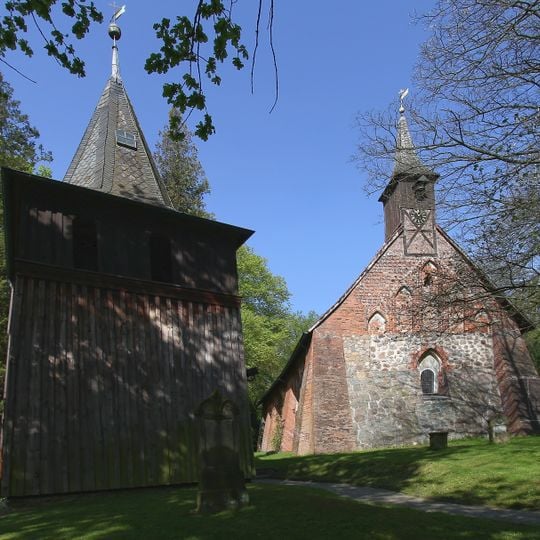
Kirche Sinstorf, Church building in Sinstorf, Hamburg, Germany
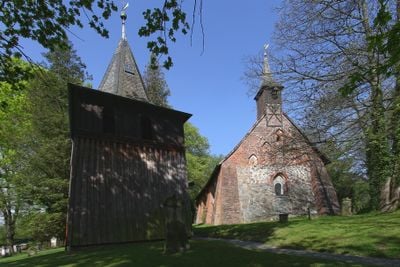
Kirche Sinstorf is a fieldstone church on a hill in Sinstorf, now part of Hamburg's Harburg borough. Since the 1416 rebuild it has been a single-nave hall church: the former north aisle was given up and the remaining aisle merged with the nave, so the three-nave basilica of about 1200 survives only in four Romanesque round-arch windows in the north wall and two walled-up arcades. A neo-Romanesque west porch was added in 1906–1907 under Karl Mohrmann, and a free-standing timber bell tower with a steep tiled roof stands to the south-east.
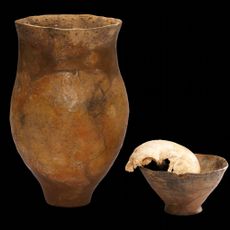
Excavations in the 1960s found traces of a wooden church from the 11th century, possibly preceded by an earlier wooden building. Around 1200 a three-nave fieldstone basilica was built on the hill, also serving as a refuge with defensive ditches. After destruction, the church was rebuilt in 1416 into its present single-nave form, with the north aisle abandoned and a round west tower added. In 1660 the choir was widened to create a hall church, and the round tower was demolished.
The church's name is not St. Ansgar, as is sometimes claimed; no evidence supports that patronage, so it is properly called Kirche Sinstorf. Inside, a relief by Lüneburg artist Cord Snitker from around 1480 shows the "Swoon of Mary," and 30 oil paintings on the gallery depict apostles and prophets. The damaged epitaph of Conrad von Windheim, preacher here for 37 years, hangs on the south wall.
The church stands on a hill in Sinstorf, with the separate wooden bell tower to its southeast and a stone monument on the grass in front. The churchyard, used as a cemetery until 1885, still holds several old gravestones. The walls were reinforced with cement between 2004 and 2006 after the 1906–1907 buttresses added weight instead of support.
The oldest bell was recast on 9 June 1773 by Hamburg founder Johann Nicolaus Bieber from a bell already 299 years old. Requisitioned in 1943 for the war industry, it returned undamaged on 24 April 1947. Two other bells, a 1699 striking bell and a smaller 1835 one, were melted down in the First World War.
The community of curious travelers
AroundUs brings together thousands of curated places, local tips, and hidden gems, enriched daily by 94,549 contributors worldwide.