Village church Pinnow, Romanesque Revival church in Pinnow, Germany.
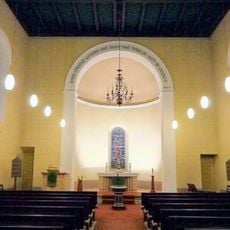
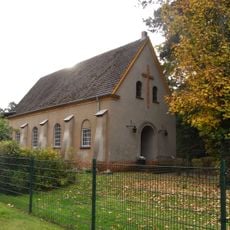
Village church Pinnow is a Neo-Romanesque hall church built in 1861–1862 under the supervision of Friedrich August Stüler. It stands on a base of Rüdersdorf limestone and is built of yellow Birkenwerder bricks, with a slender west tower. Inside, the apse is painted with a blue starry sky and the nave walls with imitation marble.
A church in Pinnow was first documented in 1597; it decayed after the Thirty Years' War depopulated the area. A timber-framed church of 12 by 7.5 metres was built on the present site in the 1680s. From 1861 to 1862 a neo-Romanesque hall church by Friedrich August Stüler rose on a Rüdersdorf limestone base, costing 7860 Taler. It was abandoned for worship in 1971.
Since 2005 the church has been Brandenburg's first Radfahrerkirche, a rest stop on the Berlin–Copenhagen cycle route, open on summer weekends. It also hosts cultural events, and a support association founded in 2002 works to keep it open.
The church is not in the village centre but in Pinnow, a residential place of the Borgsdorf district, near the Berlin–Copenhagen cycle route. It is open on summer weekends; outside those times, access depends on events. The roof, tower helm and tower outer walls were repaired in the 1990s.
The building employs brick in a way typical of northern German construction methods that differs from stone structures found further south. This regional approach to building gives the church a distinct character within its local architectural context.
The community of curious travelers
AroundUs brings together thousands of curated places, local tips, and hidden gems, enriched daily by 94,488 contributors worldwide.