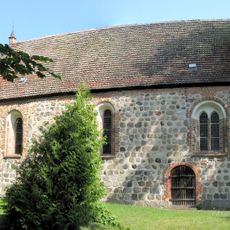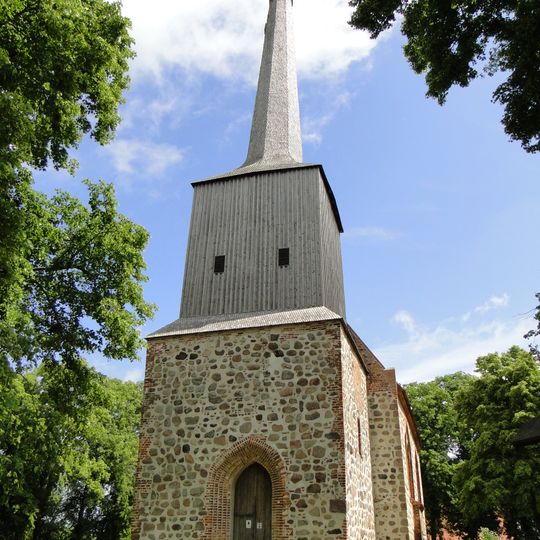
Church in Ruchow, Gothic church building in Mustin, Germany.
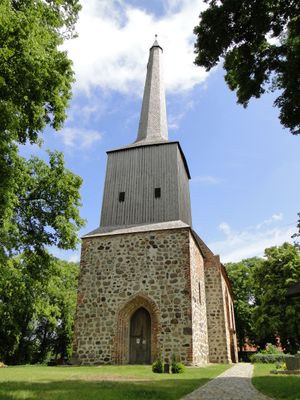
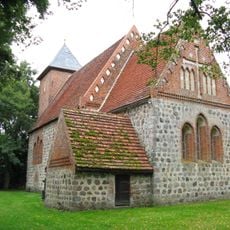
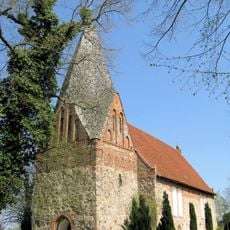
The Church in Ruchow is a single-nave fieldstone building erected around 1275, with a square box choir dating to 1267 and a recessed west tower. The tower's stone base is late medieval; its boarded wooden upper storey is dated 1614 and carries a slender, visibly leaning spire clad in grey boards. Brick decoration marks the choir gable, and the nave and choir are separated by a pointed triumphal arch.
Ruchow was first documented on 27 October 1234 as "Ruchow Ecclesia cum Omnibus pertinentii suis", when Bishop Brunward of Schwerin granted the Dobbertin nunnery the archdeaconate over the church. The fieldstone nave was built around 1275, with a square box choir dated 1267, in the Romanesque-Gothic transitional style. In 1320 Prince Henry the Lion stayed in the church and issued a charter there. The boarded wooden tower storey is dated 1614; in 1653 a visitation found the church re-roofed in stone and again fitted with a tower whose tall spire was singled out for praise.
The church serves as a focal point for the local community and reflects the Lutheran faith that has shaped this region for centuries. Walking around it, you notice how the building remains central to the village's identity and gathering life.
The church is easy to locate as it stands in the village center of Ruchow and is visible from the road. Visitors should expect a quiet, rural setting and daylight hours offer the best conditions for exploring the building and its details.
The tower's spire is visibly crooked, and the 1614 timber belfry is clad in vertical boards. A local legend says the first church was built without a tower because the Brüsehaver knights promised a reward to the builders who finished first among Witzin, Groß Raden and Ruchow.
The community of curious travelers
AroundUs brings together thousands of curated places, local tips, and hidden gems, enriched daily by 94,016 contributors worldwide.