Stapelmoorer Kirche, Medieval church in Weener, Germany
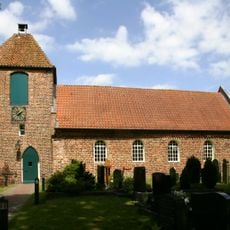
The Stapelmoorer Kirche is a Romanesque-Gothic cross church built between 1250 and 1275 on a warft in Stapelmoor, now part of Weener. Its Greek-cross plan has no right angles, and the exterior remains unchanged in its simple, uniform design. The west tower with saddle roof, pointed-arch windows and portals, corner pilasters, and a triple window on the east side are visible; the original side apses are gone but traceable in the masonry.
Built between 1250 and 1275 on a warft as a fortified church, it first served as a filial of the church in Aschendorf, a few kilometres south, and probably replaced a wooden predecessor. Arrow slits in the west tower remain from its defensive role. After the Reformation the altar was removed, windows enlarged and ceiling paintings whitewashed; a lightning strike in 1800 led to the upper tower being rebuilt lower.
The ceiling paintings with fabulous creatures, geometric symbols and plant ornaments survived the Reformation, when they were whitewashed; they were uncovered again in 1967. An inscription of 1443 on the north-east crossing pier marks the former rood screen, whose remains are kept in the Rheiderland local museum. The pulpit dates from around 1600, its hexagonal sounding board from the 19th century.
The church stands on a warft, an elevated mound, in the village of Stapelmoor, part of Weener. The west tower with its saddle roof and the adjacent parsonage, dated 1429, help orient visitors. The building is an active Reformed parish church, so visits should be timed around services.
The ground plan is a Greek cross with no right angles: every wall stands slightly askew. Unlike the similar cross church at Bunde, Stapelmoor never underwent major rebuilding, so the exterior keeps its uniform, plain 13th-century form.
The community of curious travelers
AroundUs brings together thousands of curated places, local tips, and hidden gems, enriched daily by 93,965 contributors worldwide.