Dunum Church, Medieval church building in Dunum, Germany.
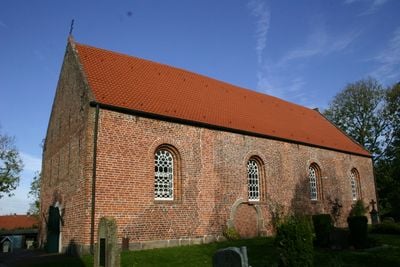
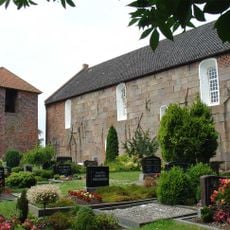
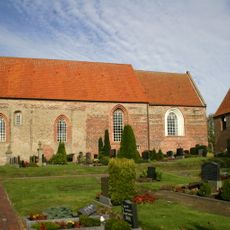
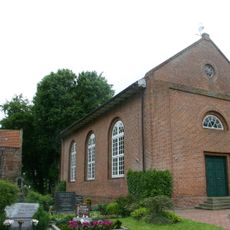
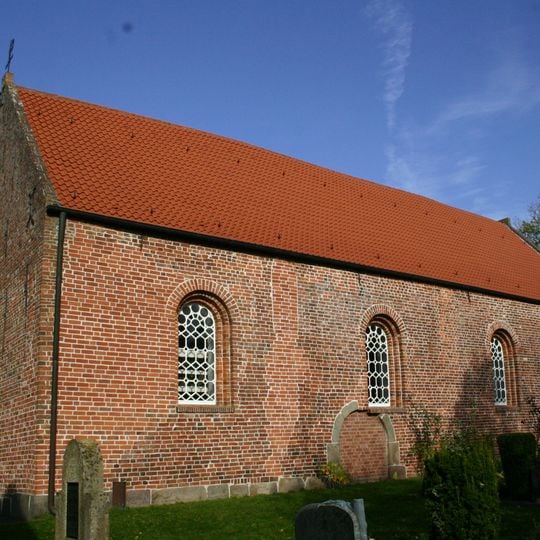
Dunum Church is a Romanesque brick church begun around 1200–1220, with a recessed semicircular apse and a steeply pitched roof of orange-red tiles. Its long walls are pierced by eight large round-arched windows inserted around 1860, and the building rests on a foundation of granite boulders atop a warft raised about two metres. A detached bell tower stands apart, as is typical in East Frisia.
Construction of the brick church began between 1200 and 1220, replacing a wooden predecessor dated to around 1000. Bricks were made beside the site and mortar lime burned from local seashells; the building rests on granite boulders on a raised warft. After 1525 Ricardo Hicco preached the Reformation here in the Harlingerland. The west gable was renewed in 1712, and around 1860 eight large arched windows were cut into the walls.
The parish has about 1,000 members, and its brass choir, founded in 1879, is the oldest in the Harlingerland. The pulpit was built in 1769 by the Esens carpenter Gerdt Behrens and painted in 1770 by Claes Röttgers of Wittmund. A pewter communion jug was donated in 1700 by Hinrich Johannsen Kuchenbäcker of Esens.
The building is located on Hauptstraße 30 in Dunum, Lower Saxony, where it is easy to find. For current information about events or visiting options, it is recommended to contact the church administration before your visit.
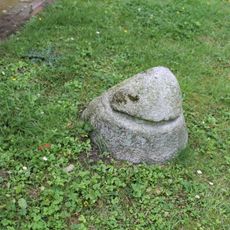
The granite font likely survives from the wooden church of around 1000. Unlike most 13th-century East Frisian fonts of Bentheimer sandstone, it was carved from a glacial boulder, with four half-figures folding their hands into the basin rim. Outside, at the height of the blocked hagioscope, medieval sharpening marks show where weapons were blessed and holy masonry scraped away.
The community of curious travelers
AroundUs brings together thousands of curated places, local tips, and hidden gems, enriched daily by 93,948 contributors worldwide.