Heunischenburg, Archaeological site in Upper Franconia, Bavaria, Germany
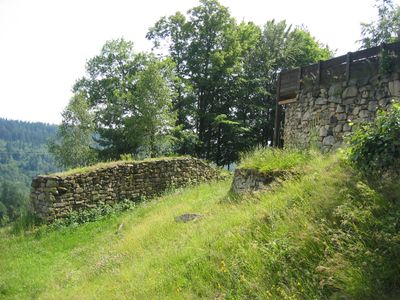
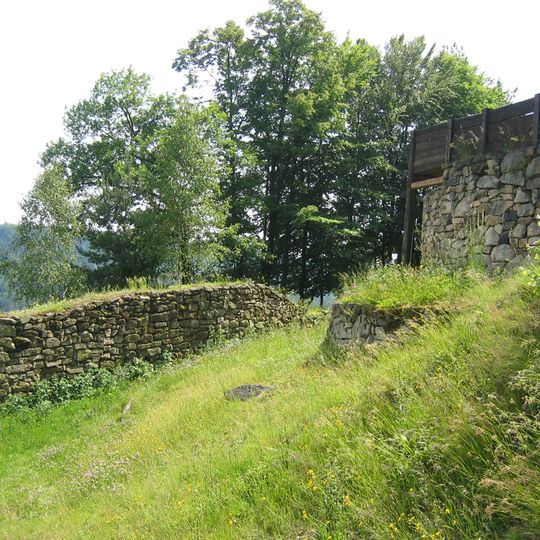
Heunischenburg is a late Urnfield-period stone fortification on a 486-metre spur of the Wolfsberg between Kronach and Burgstall in Bavaria. Its eastern flank is closed by a 110-metre sandstone wall, 2.6 metres wide and 3.5 metres high, fronted by a 3.5-metre berm and a shallow ditch; elsewhere steep slopes and a wooden palisade completed the defences. A pincer gate with a 1-metre-wide rear portal and projecting wooden tower, plus a sally port, show late Mycenaean influence.
The Heunischenburg was built in three phases: a palisaded fort in the 10th century BC, a sandstone wall that probably burned in battle, and a strong hillfort in the 9th century BC. It is the oldest known and archaeologically investigated stone fortification north of the Alps. In 1986 and 2000, a section of the final wall, the gate with its wooden tower and the gateway passage were reconstructed.
The name Heunischenburg likely derives from "Heunen" (giants), whom medieval people imagined as the fort's builders; another reading links it to something from a grey, legendary past. Visitors can see the reconstructed pincer gate and sally port, whose design points to late Mycenaean influence and contact with the Mediterranean world.
The fort sits on a 486-metre spur of the Wolfsberg between Gehülz and Burgstall, reached on foot; no road leads to the summit. The reconstructed wall section, gateway and gate passage from 1986 and 2000 can be walked through and are the only reconstruction of their kind in southern Germany. The steep slopes on all but the eastern flank make sturdy footwear advisable.
The fortification protected a strategic copper and tin trade route through a 110-meter-long rampart on its eastern flank. This defense was critical for controlling commerce in these valuable metals across the ancient world.
The community of curious travelers
AroundUs brings together thousands of curated places, local tips, and hidden gems, enriched daily by 92,803 contributors worldwide.