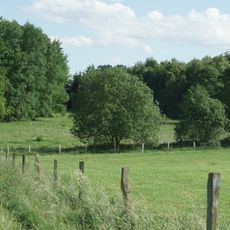
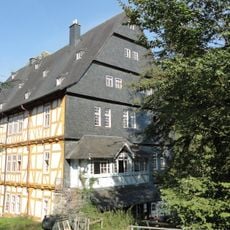
Ehrenburg, Castle ruin in Herzhausen, Germany
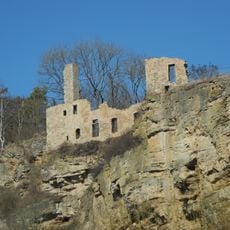
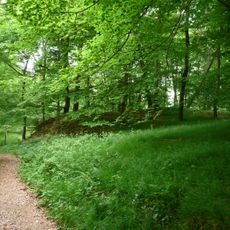
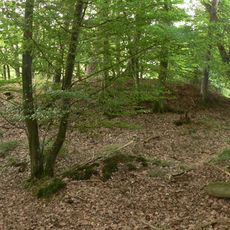
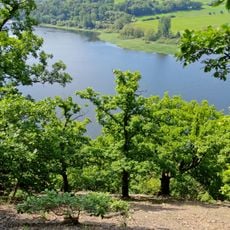
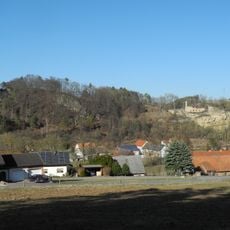
Ehrenburg is a castle ruin situated on elevated ground near Herzhausen in the Hesse region. The stone remains preserve traces of medieval architecture and offer views across the surrounding countryside.
The Ehrenburg was probably built in the 8th or 9th century, likely by the Archbishop of Mainz. Around 1354 it was rebuilt, and the younger core castle is attributed by the Vöhl church chronicle to the Counts of Schwalenberg. A charter issued at the castle on 27 July 1043 records them receiving goods at Herzhausen in fief from Corvey Abbey; apart from this disputed document, no further records of the castle survive.
The castle is known locally as Geldloch, "money hole", after the semicircular wall stump about 2.5 m across that is read as the base of a keep. A document issued at the Ehrenburg on 27 July 1043 records the Counts of Schwalenberg, ancestors of the Counts of Waldeck, receiving goods at Herzhausen in fief from Corvey Abbey.
The shortest approach starts in Herzhausen, where a path branches northeast from the L3084 along the Edersee toward the Hochstein campsite; the ruin's spur lies just before the campsite, after a stream. The Kellerwaldsteig and Urwaldsteig Edersee long-distance trails pass south of the ruin along the lake's north shore, with short access paths climbing to the site. The terrain is uneven and the final climb steep, so sturdy footwear helps.
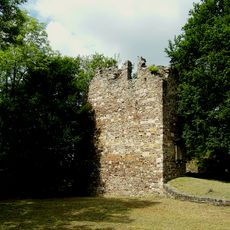
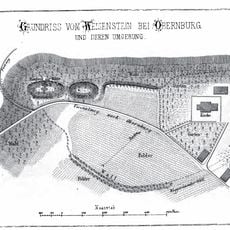
The small semicircular wall remnant, about 2.5 m across, is thought to be the stump of the keep and is popularly called the Geldloch, or money hole. A rectangular tower foundation roughly 5 × 6 m survives at the southwest corner of the main castle. The 160 m spur was built on across about 60 m of width.
The community of curious travelers
AroundUs brings together thousands of curated places, local tips, and hidden gems, enriched daily by 93,778 contributors worldwide.