Heilbruennl, Roman Catholic pilgrimage church in Roding, Germany
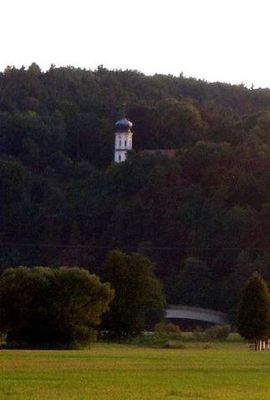
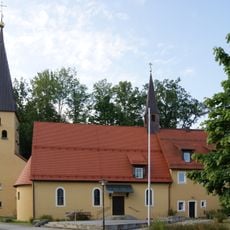
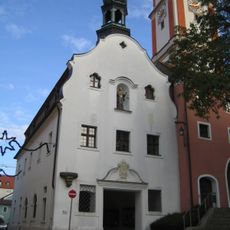
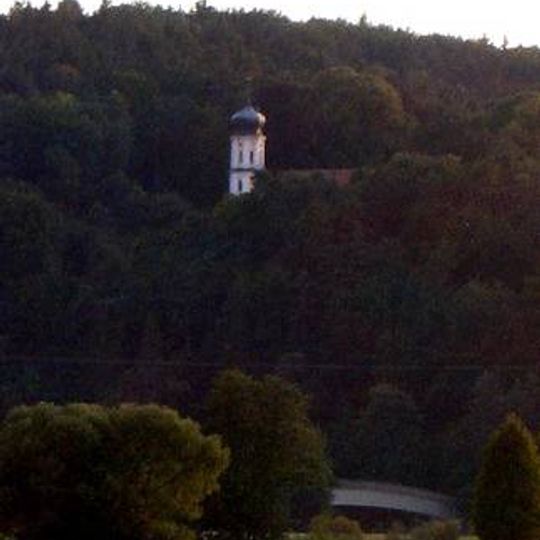
Heilbrünnl is a Roman Catholic pilgrimage church west of Roding on a hill above the Regen river. The late-Baroque hall church has a plain white facade, a hipped roof, and a slightly recessed choir with an octagonal turret topped by an onion dome. A two-storey hermitage was added next to the entrance in 1749. Inside, an oval red marble basin about one metre high collects water from the Heilbrünnl spring in the centre of the nave.
The pilgrimage began, by legend, when a shepherd found a Marian image in a spring; the parish priest of Roding recovered it and had it placed in a shrine there. A chapel stood at the spring from 1668 and was enlarged 16 years later; the present church replaced it in 1730. A Leonhardiritt was held here annually until the 19th century.
Visitors come to collect water from the natural spring, showing how deeply the belief in this place's healing power runs through the region. This faith has endured across generations and continues to shape how local people relate to the site.
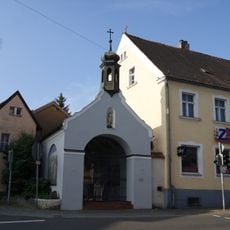
The church stands on a hill west of Roding above the Regen river, so the approach is uphill. Entrances are on the north side, where a copy of the Marian image hangs on the facade, and on the east side next to the two-storey 1749 hermit's house. The spring basin sits in the middle of the nave in front of the choir.
The spring rises inside the nave itself, not outside the church: its water is caught in an oval basin of red marble with white flecks, about one metre high, set centrally before the chancel. Pilgrims wet their hands and eyes with it, as it is credited with healing eye ailments. In the hot summer of 2022 the spring dried up for the first time.
The community of curious travelers
AroundUs brings together thousands of curated places, local tips, and hidden gems, enriched daily by 94,636 contributors worldwide.