Eliasfriedhof, Cemetery in Pirnaische Vorstadt, Dresden, Germany
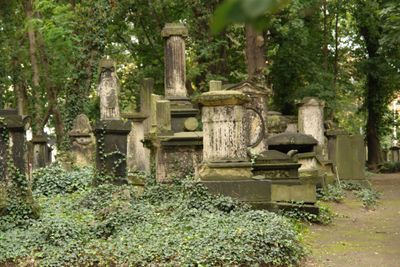
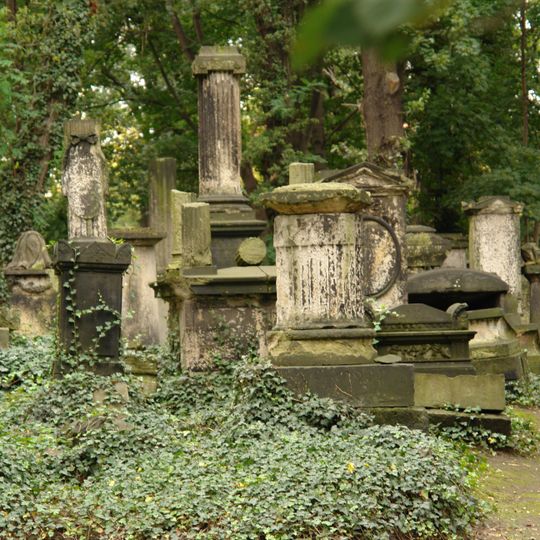
Eliasfriedhof is a cemetery in Dresden located in the historic district near Ziegelstrasse, containing numerous gravestones and monuments spread across its grounds. The burial ground features various sections with different layouts and planted areas that reflect different periods in its development.
Dresden's plague of 1680 killed over 5,000 people, a third of the population, so Elector Johann Georg II ordered an emergency cemetery outside the city; the land before the Ziegeltor was sold to the council on 10 July 1680. After the epidemic it served as a poor cemetery. In 1723 George Bähr and Johann Gottfried Fehre rebuilt it as the burial ground of the nobility, adding 41 vault houses along the west and north walls.
The name Elias-Kirchhof, after the prophet Elijah who could raise the dead, replaced "Neuer Kirchhof" in the 18th century; Johann Christian Crell gives the first record. Burials were granted as hereditary leases and the vault houses could be sold as private property. Among those buried here are the composer Johann Gottlieb Naumann and the painter Johann Christian Klengel.
The cemetery has been closed since 1924 for traffic and security reasons, so visits are not open to the public; access is arranged with the responsible monument authority. The grounds cover 13,162 m² in the Pirnaische Vorstadt. The 41 Grufthäuser line the west and north walls, while the graves not at the wall face east.
The cemetery's name comes from the prophet Elijah, who could raise the dead. The first documented use of the name Elias-Kirchhof appears in the writings of Johann Christian Crell. The site was originally a plague cemetery, and later the burial place of Dresden's nobility and wealthy citizens.
The community of curious travelers
AroundUs brings together thousands of curated places, local tips, and hidden gems, enriched daily by 93,427 contributors worldwide.