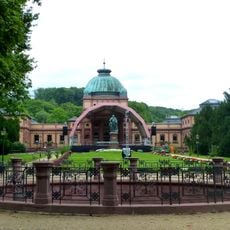
Elisabethenbrunnen, Water well in Kurpark Bad Homburg, Germany.
The Elisabethenbrunnen is a spring enclosure in the Kurpark of Bad Homburg vor der Höhe, redesigned by 1918 under Kaiser Wilhelm II. Sculptor Hans Dammann gave it its present form: a round temple with a marble statue of the Greek goddess Hygieia. The water is a sodium chloride acidulous spring at 10.5 degrees Celsius.
The spring was discovered in 1834 and studied for its healing properties. The current structure was built in the 20th century to establish this location as a symbol of the spa town.
The spring is named after Princess Elisabeth, wife of Landgrave Friedrich VI of Hessen-Homburg and daughter of British King George III. Its water, a sodium chloride acidulous spring at 10.5 °C, was used to treat stomach and intestinal complaints. Visitors can draw the water themselves at a simple tap at the edge of the Kurpark, close to the street.
The fountain is located within the large Kurpark and is easily accessible via multiple walking paths. The area suits leisurely exploration, with benches and other attractions nearby.
The 1918 temple by sculptor Hans Dammann cost 100,000 marks, donated by industrialist Wilhelm Becker, whose steelworks profited from armaments contracts in the First World War. The design is said to go back to an idea of Kaiser Wilhelm II himself.
The community of curious travelers
AroundUs brings together thousands of curated places, local tips, and hidden gems, enriched daily by 93,765 contributors worldwide.